Monday, April 5, 2010

Ex Machina #40

• NOTE • This review was written shortly after the release of issue 40, and I have re-published it here with only two changes, both regarding grammar. • NOTE •


Ex Machina 40

-Ex Machina- (eks•mock•een•uh): Referencing the Greek stage mechanism of the Gods appearing during the denouement of plays to resolve the conflict quickly and somewhat unexpectedly; Deus Ex Machina, translated, means "God from the machinery." Generally viewed as a weak or hackneyed method of wrapping up a story.

Written by Brian K. Vaughan, illustrated by Tony Harris, and published through WildStorm Comics, Ex Machina is the tale of New York City resident/Mayor/former superhero Mitchell Hundred. It takes place in many settings, including varying years. Readers have seen Hundred as a young boy asking his mother about leagues of women voters, as an adult dealing with the everyday happenings of a city that never sleeps, and also witnessed glimpses into his days as the high-flying hero, the Great Machine.

This book is definitely not hackneyed or weak.

Over the course of 40 issues readers have been taken through a tale that has touched on many different themes, some of which include a general sense of belonging, gay rights, drug use, and on and on. We may never know whether scribe Brian K. Vaughan is filling the pages of his second finite series after "Y: The Last Man" with his own beliefs and opinions, but something that is certain is his knack for crafting a compelling story, creating characters that dare to be as broad and varied as people so often are on this stage we call real life.

Likewise, Tony Harris takes Vaughan's words and turns them into gorgeous images, faces rendered so wonderfully true to life that readers can see the emotions and understand that this book is working on more than one level; it is a fantastic example of why comics are so entertaining when they are created successfully, when the art compliments the words, and vice versa.

I love this book. It arrived at a time when I was becoming somewhat more politically minded, and the idea of a superhero who ends up becoming the mayor of arguably the biggest city in the world (metaphorically) was intriguing enough for me to pick up the first issue. Vaughan managed to make a book about politics entertaining to someone (me) who finds most political conversation/theory boring and tedious, and usually gets informed of such by watching the "Daily Show."

This book has literally taught me things. At the moment the only thing I can think of is the definition of the word "constituent," but I'm positive there have been other lessons learned. Even if that isn't true, expanding my vocabulary is a win in my mind, and is certainly something America should look into.

My most recent lesson came with issue number 40, the issue I would undoubtedly characterize as Brian K. Vaughan's most personal to date. It was also my least favorite. There's something strange about this process, me selecting my least favorite issue, if for no other reason than trying to select the one read I disliked the most out of a series I like immensely is kind of counterintuitive. Alongside that, the idea that Mr. Vaughan took his personality and feelings and created this issue makes me somewhat reverent, so trashing the thing is kind of a dick move.

But then there's the critic in me, the side of my brain that realizes I won't enjoy everything, and that same side knows any artist who possesses their own critical mind understands that not everyone will enjoy everything they produce. My disappointment with the issue began the moment I saw it on the stands.

Featured on the cover is our faithful writer, Mr. Brian K. Vaughan, and his penciller, Tony Harris. Immediately I recognized the kind of story I was in for, and I think my exact reaction was something along the lines of "Ugghhhhhh." Issue 40 is a metafictional mess, a story that features the creators of the series which it is taking place in; essentially, it's like watching a movie of yourself watching a movie. I have seen the "meta" approach work very rarely, and one example is the film "Adaptation," written by Charlie Kaufman and directed by Spike Jonze. The majority of other occasions where an artist has saw fit to become self-referential has failed for me, and done nothing other than the exact thing which Brian K. Vaughan (the character) mentions in this issue: negatively affected my reading experience.

Tony Harris and Vaughan are visiting Mayor Hundred to see about working on his memoirs, which are to be published in comic book form due to the Mayor's love of the medium. While they are waiting for their appointment to arrive Tony Harris takes out his portfolio and begins sketching. "What are you working on?" Brian K. Vaughan asks. "Just sketching the two of us sitting out here in the waiting room. If we land this project, I thought it'd be cool to draw you and me into the first scene," Tony Harris responds. "Oh...yeah...I don't know, Tony. I'm not big into the whole Grant Morrison 'meta' thing. Seeing creators in a book kinda takes me out of the story, you know...?" I even view Vaughan's reference to self-referential storytelling tired, and not at all funny. In fact, while reading it, I found myself going, "Yes! You're right. This sucks."

My big problem with this issue is that it smacks of the word "filler." With issues hitting the stands with ever increasing irregularity, when I picked this one up and saw exactly what was inside, my gut reaction was that Vaughan had written something quickly, an easy story to put something out there so WildStorm would have an issue of "Ex Machina" to sell.

During the story Vaughan meets Mitchell Hundred, and they discuss his graphic novel memoirs, but quickly segue into a discussion of Vaughan's personal life, mainly his Missing-In-Action girlfriend, who moved to California for grad school.

"And why the hell didn't you follow her?" Hundred asks. This is where it may or may not get personal. Brian K. Vaughan (the character), tells of watching the first World Trade Center collapse, sitting on his roof and witnessing the mayhem. While he was out there he saw his neighbors, which is referenced as an odd occurrence for New York City. After that he describes watching the Leonids (a meteor shower) from that same vantage point, and seeing the same people whom he'd witnessed complete horror with. They were smiling, oohing and aaahing, and it was like sitting on a lawn during the 4th of July for Vaughan (the character), and thus his love for New York was defined. Hundred responds by saying that he can write comics from anywhere, no? Of course Vaughan says yes, and this is where the one piece of this issue arrives that may offer up something other than a goofy meta story designed to fill a hole on the shelf.

"If you're not with your people, a city is just a fucking place. Even this one," Hundred says. Right there, we are given Hundred's dedication and love for New York City, and that is my guess as to what Brian K. Vaughan (the writer) was trying to do with this issue. Unfortunately, if the readers had been paying attention over the previous 39 issues, they probably already knew that. After all, this is a guy who became a superhero when he realized he may be able to help people other than himself, and transitioned into the role as Mayor when he decided that would be a more actionable position. In my mind those two things prove the love of the city in themselves, so this issue was essentially unwarranted.

I have no idea if any of the stories Brian K. Vaughan (the character) relays are true or not. Maybe he did watch the horror on that day in September from his roof, maybe not. I don't know everything about the guy, and realistically, I don't want to. I do know that his wife's name is Ruth, however, and the title of this story is "Ruthless." The fictional Mayor Hundred asks why Vaughan didn't follow his girlfriend to California, and Vaughan responds, "You." So maybe that means (in reality) he stayed in New York for a little, working on this comic I love so much, and eventually realized he could write the thing from the opposite coast, where the love of his life had relocated.

Then again, maybe not. Oddly enough I've reread this issue about five times. I think I get some sort of strange satisfaction from having an issue of one of my favorite comics I dislike so much. With it being written by an author who is attempting to make this fantastic story as true to life as possible, and an artist doing the same, I came to this understanding: not every day is a great one. Through that, I came to enjoy this issue, mostly because I dislike it so much.

A Reviews Review

Internet journalism is a much different form than the increasingly outdated and ancient form of print journalism. There is simply far less attention to content when all it takes to publish opinions is a click of a mouse.

Reviews aren't normally on my reading list, but recently I woke up and decided I'd read a few. It was a sad morning.

- • -

The first review I read was interesting in that it presented a markedly staunch opinion. More than that, it was negative. The reviewer hated the book, and gave it one star out of a possible five. This was interesting because I didn't hate the book in question, and it's always interesting to read differing opinions.

Overall it was a fine review, but most of the negative aspects the reviewer mentioned seemed somewhat strange to me; the pacing, for instance. Since it was an action comic, written by a writer known largely for over-the-top action, with little to no attention to the finer details of a character and his/her development, this seemed a strange gripe to have.

I decided if I was going to run this experiment - as I was thinking of it finally - I should read another review, specifically one that had a differing opinion than the first. If I managed to find such a review, the chances were high it would fall somewhere close to my opinion, which was this: the comic was just okay.

- • -

There was in fact an opposing opinion, which isn't really so outrageous. What is the internet if not a collection of differing opinions?

The second review I read was an odd one. It purported to be praising the book, but when I looked deeper into the reviewer's words I discovered he was mixing his opinions. There was one phrase that summed up the entire review process for me: "this book is not for everyone." This statement is so obvious as to be redundant, and could potentially chop down the entire process to a much more abbreviated form.

Here is my review of the book in question, utilizing both reviews I read. "This book is not for everyone. If you like action, buy it. If you do not, then don't. The characters seem two-dimensional, but that is excusable because it's brainless violence. Rating: F or B+."

- • -

There are a few problem with comic book reviews. The most obvious is length. Most places that publish reviews of comic books are going to seek reviews that don't break past a certain amount of space, or when interpreted into the significance to the reader, a certain amount of time. After all, we're talking about comic books, which are a very limited investment of time, much more limited than novels. I certainly don't share in this opinion, because if I'm truly interested in something I'll forego any worries about wasting my time.

Maybe it's subconscious. Comic book reviewers, and the sites that publish them, don't spend too much time reviewing books because they know that the majority of those visiting the site won't read the entire review if it's too long. This may or may not have anything to do with the length of a comic, but more with the use of the internet and how it has become a tool of convenience, or a way to waste time in short increments.

- • -

There are definitely reviews out there I enjoy, but it's hard to find them. I like to read a review where the writer isn't afraid to write everything they think, and not an abbreviated form of it. The need to edit or limit a writer's space (content, meaning the amount) is understandable occasionally, more so in print than on the internet. There is no worry about printing cost or ad placement, so really the only thing restricting reviewers and their words is time; both theirs and the readers'. Honestly, what are the odds that someone read this entire posting?

My next post will be a review I wrote about a comic book I love. It is a negative review, however, and pretty long.

Friday, March 19, 2010

Everything Is Not Great (Or Awful)

A ton of stuff has happened since I posted last, including the release of the cover to Scott Pilgrim volume six, along with the official movie poster. Oh, and Chris Evans was confirmed as the actor playing Captain America in the film, but I'm going to skip all of that and talk about something else instead.

A posting over on Robot 6 led me to another posting, this one by blogger Erin Polgreen, where I read about Mark Millar potentially being a racist and/or sexist. The comic book world is a small one, and generally you can have contact with almost any creators - there are exceptions - and if you don't, then somehow, someway your words can find a way to reach the ears they are addressing. It's a concern as old as the concept and practice of journalism itself, but one that hasn't decreased in relevance today.

How much should a journalist (or commentator, observer, critic, whichever adjective is being used) allow the reception of his/her words to affect which words are put forth?

I've read countless issues of Wizard magazine filled with unbounded praise, limitless kind words regarding anything they decided to write about. I can't remember a single time I read an article or feature critiquing an artist or writer's work, giving an unfavorable review of anything. The argument has been posed that to go out of their way to pan comics would be counterintuitive; why not focus on the good, or entertaining ones?

I've always been a member of both modes of thought. The positive is great, but it is made relevant by the negative. Everything is not great. But, and this is really important, everything is not awful.

- • -

My first experience with a Mark Millar book was "Red Son," published by DC. I loved that book, and still do to this day, although my love of it is starting to seem weaker each year if for no other reason than my enjoyment of other Millar works has been either minimal or non-existent. It's not that I can't enjoy a single entry in an author's oeuvre while simultaneously being underwhelmed or disappointed in the rest. I haven't read "Red Son" in a few years, and I'm starting to wonder if my level of enjoyment will be less than it was originally.

Miss Polgreen discusses in her article the reasons she thinks Mark Millar is racist and/or sexist. Although she brought up some great points, and discussed pieces of Millar's past writings, I found myself wondering if I read comics with the same mindset she, and other critics, need in order to come up with these thoughts regarding the works. Initially I thought no. So instead of reacting to her accusation of Millar's sexism and racism I went into a bout of navel-gazing. Maybe that's what writing is supposed to do, maybe not. Either way, I wondered if I did (or could/would) read comics in the same way Polgreen was.

I hate to say she was searching for the offending bits, because her reading habits or practices are completely unknown to me. The only reason a thought like that even comes up is because when I read a comic I am somewhat disconnected, meaning that I usually try to switch my critical mind off. It's not always easy - markedly so when the comic isn't good - but I try to arrive at a place where I feel as if I am inside the world being created for me.

- • -

Mark Millar has done plenty for me to dislike him as a writer; I don't know him personally. "Kick Ass" was optioned to become a film before the first eight-issue story was even on the shelf; hell, before the first three issues were more than an outline. He started a comic called "War Heroes," with an entire year separating the publication of the first and second issues. He has all but abandoned the comic book world, and these are the most glaring offenses I think of when I think of Mark Millar, or his comics.

Sexism and racism are much harsher condemnations, I think, and not that I necessarily avoid those labels, but they tend to not surface in my mind right away. After reading Miss Polgreen's article...I dont' know.

In issue eight of "Kick Ass" main character Dave Lizewski tells the girl he's been lusting after that he was in fact pretending to be gay to get closer to her, and Millar tricks the reader with a false account of her fawning over him, saying how glad she is that he's finally come clean. THEN. You hear the real account, where she tells Lizewski how pathetic he is, and sends him a picture of herself blowing her boyfriend, whom Millar goes out of the way to categorize as some certain ethnicity other than white.

Although I didn't read this and immediately think, "Whoa, racist AND sexist," I did decide that "Kick Ass" was no longer a book I'd read. Up to then I'd already been getting marginal enjoyment out of it, so the loss wasn't huge.

Read Polgreen's article and see what you think. Although Millar seems to be repeating himself with the amount of potentially racist or sexist material he puts in his books, it's dangerous to label a creator as either when it is their characters delivering the evidence. On the other side of that coin, if a creator puts enough racist, sexist, or some other offending bit into their work on a regular basis, can the reader/viewer/consumer make an educated guess about their beliefs?

Tuesday, March 9, 2010

One Reason To At Least Look At the 'Unwritten'

If you weren't already paying attention to Vertigo's ongoing series "The Unwritten," maybe this image will convince you to do so.
Unwritten #14
Drawn by Yuko Shimizu, this is the cover to issue fourteen of the series. This is one of those covers that makes me really want a comprehensive book to be released containing all covers of a series. Some fans would surely have a problem with this, and avoid purchasing the thing because they are in essence buying the same thing twice.

There are various ways around this, including special features, which are increasingly included in compilations/trade paperbacks/graphic novels now. These could include a multitude of items, but the ones that come to mind first are interviews with the artist, examples of the process such as thumbnail sketches, rough layouts, pencils, inks and so forth. I would definitely buy one for certain series I follow that are still active, and for some that have finished.

Vertigo has released "Fables Covers: The Art of James Jean Volume 1," but this seems like the exception. I would definitely buy a book of covers from "Y: the Last Man," "Ex Machina," and "The Unwritten." Maybe Vertigo has plans of doing this, but "Y: the Last Man" has been finished for some time now, and "Fables" is currently still running. There surely is some sort of mathematical formula out there to prove this means the James Jean book is a fluke.

Friday, March 5, 2010

Two Reviews For You

Oh Wednesday. If I were a little more poetical (?) I'd write a sonnet to you. You're the perfect middle to my week...like a double-stuffed Oreo. Instead of poetry, though, you get sad comparisons to food.

Every Wednesday I get new comics. The number usually differs, but there's always at least one, and I dread the day when there isn't even that. I'll probably end up buying a trade or graphic novel, out of the need to feel like it's actually Wednesday.

This past Wednesday - March 3 - I took home five comics, along with Absolute Sandman Volumes 3 and 4, along with the Absolute Death. I had to make two separate trips from the car to the house in order to carry all the stuff (yes, I also picked up some groceries, but nevermind that, it ruins my reminiscence).

Here are the somewhat short synopses/pseudo-reviews of the two books that hit me the hardest on this latest Wednesday.

Stephen King's "N" #1 - Written by Marc Guggenheim, penciled by Alex Maleev.

N

"N" started out as a short story published both in book-form ("Just After Sunset"), and on the internet as a "webisode," which might be the dumbest name for what the thing actually was, which we know as "motion comic" (itself a pretty derivative name). Now, after enough time that "N" was sort of fading from memories - or mine, anyway - Marvel presents the first issue of the comic book adaptation, which is based on the motion comic, which was itself based on the short story. Marc Guggenheim did the adaptation from short story to motion comic, and now he's doing the adaptation from motion comic to actual comic book. So he's adapting something from an adaptation he did based upon a Stephen King short story.

This sounds like a perfect way to convolute the process or miss the mark, but the comic book version of "N" arrived as a well-made piece of fiction. The story follows three story lines; that of the Ackerman family, the Bonsaint family, and the psychiatric patient known as "N." Again, this sounds very convoluted. Here is a very simple breakdown of the plot: "N" visits the site of the old Ackerman house, which was destroyed, killing some of the family, the others perishing at the end of a shotgun held by Papa Ackerman, who then sucked on that very same barrel and went on a buckshot ride. While at the site of the grisly murders/suicide/strange destruction, "N" notices that where the house stood there are seven pillars. He goes to take a picture, and through the lens of his camera realizes there are actually EIGHT pillars.

Insanity ensues, and it is King, Guggenheim, and Maleev's intent to drag the reader into the nuttiness, and so far, I'm right there with them. Issue two is definitely on my to-buy list.

"First Wave" #1 - Written by Brian Azzarello and penciled by Rags Morales


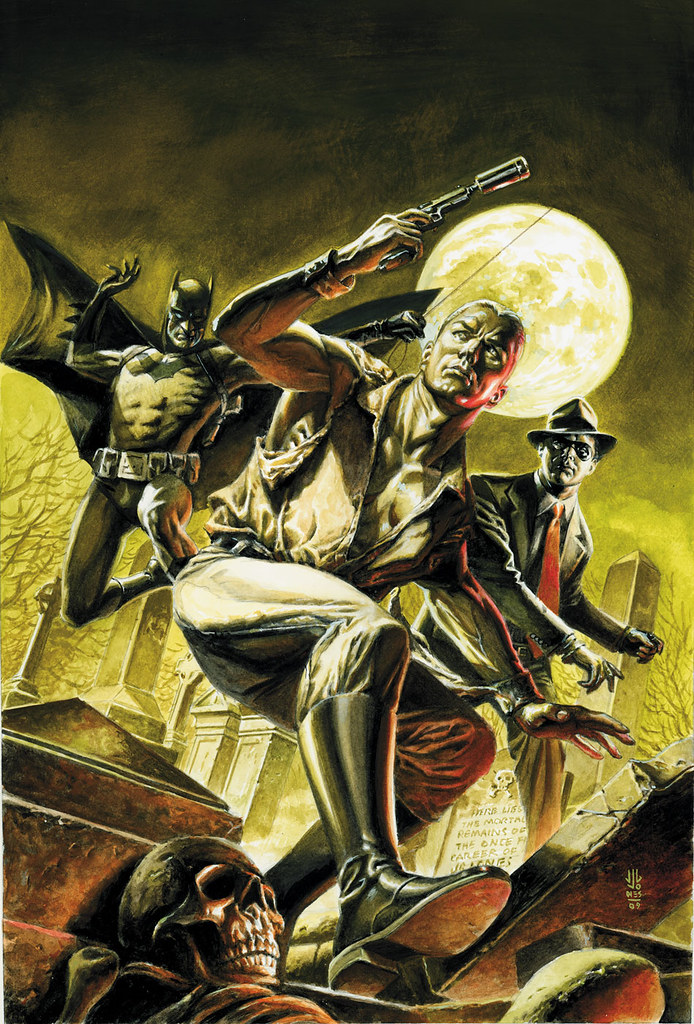
First Wave #1

This might be the week for books that seemed outrageous in concept, but delivered the promised results. "First Wave" isn't a team book, not yet, but one can certainly see the beginnings of a team. This book stars Batman, Doc Savage, the Spirit, the Blackhawks, Black Canary, and a cadre of sidekicks for each of those, not to mention the villains that we haven't really seen at this point.

That's a lot of characters to start out with. Brian Azzarello (most famous for "100 Bullets) doesn't seem daunted. He puts the pieces in place in this first issue, and delivers a book that reads exactly how it should: like a weird, alternate universe/Elseworlds tale where Batman is alive during the non-specific timeframe that looks somewhat like 1940s New York, but has some tiny modern touches as well. The reader gets crime, noir, and humor (the last compliments of the Spirit), and is left after 22 pages feeling as if they went on a very short, but very promising ride that is being built piece by piece every month.

I had to read this one twice, and am planning on a third time. The amount of characters leads to huge overlapping story lines, and is a little intimidating. If this book goes downhill in the future it will be because Azzarello cannot juggle all of the simultaneous stories, but as of now, I'm willing to watch and see if he can succeed.