Friday, February 26, 2010

Childe Austin To the Dark Tower Came

Dark Tower

It's been a long journey for me and the "Dark Tower." That may or may not be appropriate, since it took Stephen King two decades to finish his - and I love being able to use this - magnum opus.

I read the first "Dark Tower" book, "The Gunslinger," and loved the world King had created, a world that had "moved on," which always seemed like a vague reference to nuclear winter, or some sort of irreversible plague. After moving on, King's fictional world (which is called "Mid-World" within the novels) became something akin to a Sergio Leoné film mixed with a Robert Jordan novel, which is essentially a "Lord of the Rings" facsimile; but I'm not here to debate the ingredients that went into the melting pot in order to give us the "Dark Tower" books (I'd be talking about the Robert Browning poem that inspired it, surely; a guy's gotta' have standards).

Nope, this is all about me. After I read "The Gunslinger" I had to wait until I got a hold of the second novel, "The Drawing of the Three." Maybe six or seven months passed before I did, and at that point I decided to re-read the first. What happened? Thanks to "The Drawing of the Three" I decided the "Dark Tower" wasn't for me. Not only did King take the reader out of Mid-World, but he gave us some awful dialect, a black woman from the 60s, and it may or may have not been accurate, but it was certainly heavy-handed, and detracted from the narrative.

I put the book aside, and read something else. Deep inside my brain there was a tiny mechanism at work, though, and it eventually led me back to the novel, and I powered through the awful dialogue, and finished. So, after maybe a two year period, I had read the first two novels, and I immediately started the third.

Something happened to me - after finishing the third novel, mind you - that made my interest in the "Dark Tower" novels evaporate completely. What I heard was a huge spoiler, one I won't repeat here, but I'll just say it violates one of the key storytelling rules I tend to live by, and knowing this I had to put aside my past enjoyment in favor of ensuring future smiles, and went about my life.

We weren't done, though, the tower and me.

- • -

There's a list of blogs I follow, or regularly visit, and one of these belongs to the artist Sean Phillips. He's done a ton of stuff, but is most known here in the states for being the penciller behind the comics "Criminal" and "Incognito," both written by Ed Brubaker.

He recently revealed on his blog that he'll be drawing the next chapter of the "Dark Tower" comics, and even posted a thumbnail page of the issue he's currently working on. He's since taken it down, probably after getting yelled at by his editor. This was enough for me to become interested in the "Dark Tower" comics, and actually drove me to seek out the ones I missed, and see what exactly there was to be missed.

First, I was missing art by Jae Lee, which was already enough for me to wish I'd been following the single issues. Along with that, the colors by Richard Isanove (both of these evident in that picture up there - whew) were beautiful, and perfectly rendered Mid-World and its inhabitants.

Oh yeah, it's also co-written by Peter David, and the worlds runner-up when it comes to knowledge of all things "Dark Tower" Robin Furth, second only to the dude who wrote the novels originally!

The first series, "The Gunslinger Born" deftly delivered the same style and content the leadoff novel of the "Dark Tower" books gave, a sci-fi-ish western-fantasy. Reading this series you can almost hear the sand whistling along the gusts of wind. Jae Lee's panels are either intense close-ups, á la Leoné, or sweeping landscapes á la John Ford. It isn't necessarily fair to only compare Lee to others, as he brings his own unique line work to the table, gives the reader both the grit needed, and the occasional (very occasional) softness.

David and Furth expand on what readers of the original novels know of Roland Deschain and his days as a gunslinger, and do not disappoint with the delivery of all the standards of a good western - action, love, revenge, jealousy, and moody characters affected by all of these.

Now here I am again, deciding whether I should complete the "Dark Tower" novels, despite knowing a huge twist within the seventh book, and knowing how completely I hate what King did. Maybe I'll look at it all like a journey, not unlike Roland Deschain's. He knew it would be difficult, knew without a doubt that there would be moments he would despair, and maybe even seek a way out.

That's pretty dramatic for a simple decision on what to read next, though.

What's Next For Jeff Lemire? *UPDATED*

The writer and illustrator of Vertigo's ongoing comic "Sweet Tooth" is known for his moody, character-driven, and emotionally resonant stories. Not only in "Sweet Tooth," but his previous work with Vertigo, "The Nobody," and the work that launched him into comic book industry acclaim, "Essex County." Published by Top Shelf Productions, "Essex County" is a trilogy dealing with the emotional and mental goings on within small town folks. Lemire's next work is also set to be released by Top Shelf Productions, and has similar themes as "Essex County." Here is the official release about Jeff Lemire's next project, "The Underwater Welder."

THE UNDERWATER WELDER BY JEFF LEMIRE

Pressure. As an underwater welder on an oilrig off the coast of Nova Scotia, Jack Joseph is used to the immense pressures of deep-sea work. Nothing, however, could prepare him for the pressures of impending fatherhood. As Jack dives deeper and deeper, he seems to pull further and further away from his young wife, and their unborn son. But then, something happens deep on the ocean floor. Jack has a strange and mind-bending encounter that will change the course of his life forever. ... Equal parts blue-collar character study and mind-bending science fiction epic, The Underwater Welder is a 250-page graphic novel that explores fathers and sons, birth and death, memory and truth, and treasures we all bury deep down inside.

So not only is Lemire writing/drawing an ongoing title for Vertigo right now, with issues coming out regularly and on time, but he managed to write AND draw a 250-page original graphic novel? I have no idea how this guy does anything but sit at a drawing table.

Here is the first preview image of "The Underwater Welder," due out in 2011. *UPDATE* The Top Shelf page has this listed as coming out in 2012. Not sure which is the real date as of now, but if one is set in stone I'll find out.


Underwater Welder, by Jeff Lemire

Tuesday, February 23, 2010

Paying Too Much Attention: The Sandman

Absolute Sandman Vol. 1 Absolute Sandman Volume 2

Boxes were almost definitely designed and created to carry books to my doorstep. In the occurrence that I can't make it to a bookstore to buy the books, or by some terrible twist of fate they don't have what I'm seeking, online is the way to go.

Within two weeks I've had four comics brought directly to me, and the excitement of opening the boxes is a lateral move from Christmas morning, but it also has its roots in visiting the comic shop on new comics day.

Two of the books were by Canadian creator Seth ("George Sprott" and "Clyde Fans"), one was by Jason Lutes ("Berlin: City of Stones"), and these had been added to my "to read" list somewhat recently. The other two were grandfathered into the list, inhabitants since the bullet points were only in my mind. These other two were like my holy grail, although I wasn't actually searching for them, so that's a bad analogy. They are written by Neil Gaiman, though, so the British part of the whole grail analogy can stay.

The first two Absolute Sandman collections were delivered to me, and I've spent the last week or so completely rolled up inside Neil Gaiman's insane world. They are gorgeous; the writing, the art, the binding, just all around top-notch.

The first eighteen issues have been re-colored, and the update was most needed. Before buying these Absolute editions I had the first and second trade-paperbacks, and the coloring stuck out the most. The intense pastels were perfect reminders that the issues were originally printed in the 80s, and although small, this had an affect on the reading experience.

Now with brand new colors the Absolute Sandman is operating at 100%. This means you'll realize Neil Gaiman is one of the best comic book writers around, and you'll probably be sad for a short period of time, knowing that Gaiman doesn't write comics full-time anymore. This sadness will fade, though, because he DOES write novels full-time, so yours isn't a Gaiman-less world.

- • -

I had read almost all of the issues contained within the Absolute Sandman Volume 1 previously, but I had somewhat forgotten about the content of most. Re-reading them, I was reminded how fantastic a book this one is. There is probably a book's worth of praise for "The Sandman," so rather than just toss out a blanket rating or a few adjectives, I'll highlight the three stories within the first Absolute volume that are not only awesome, but are three of the best single issues I've ever read.

Issue number six, "24 Hours," doesn't feature the Sandman until the last page of the story, not strictly speaking at least. The main character of this story is Dr. Destiny, a villain from the sixties who looked like Skeletor/The Taskmaster, and was mostly harmless. Then Neil Gaiman came along, and made him look like a reanimated corpse who's "Materioptikon" - some weird machine that could affect reality - was in fact powered by Morpheus's ruby. It turns out the ruby was imbued with a portion of Morpheus's power, and since Dr. Destiny was a mere human, possessing it severely messed up the dude's head.

After escaping from Arkham Asylum he hitchhikes, picks up his (Morpheus') ruby, and heads to a 24-hour diner filled with customers; it is cover to cover insanity. Dr. Destiny opens up the customers' lives and looks at all the layers of neuroses, emotions, and fears he can find, and exploits them. Over the course of 24 hours he drags them around in his psychic (psycho) wake. There isn't really a lot of hope in this issue, but seeing how someone has been so affected by the ruby of Morpheus is interesting, and how Gaiman shows the emotions of all the different characters is pretty freaking masterful.

"Men of Good Fortune," Sandman number 13 has way less torture, murder, and madness than the sixth issue does, and is essentially the opposite side of the coin represented by issue six.

Set in the 1400s, Morpheus walks into a tavern and overhears a boisterous drinker talking about how death is a fool's game, and he's not going to be a follower, someone who dies because everyone else on the planet does too. In response Morpheus says, Yeah, well how 'bout you meet me back here in a hundred years? So that's what happens.

- • -

It's a lot easier to tell from the early issues of "The Sandman" that Neil Gaiman wasn't sure what he had inside his own head. The DC imprint Vertigo was in its infancy, and the modern version of the publishing house was barely a sketch on a page. The division between Vertigo and the regular DC universe was thin. The character's whose name Neil Gaiman was utilizing makes an appearance, as does Etrigan, the Justice League International, and other characters including Dr. Destiny, who was an old Justice League of America villain.

Regular DC universe characters/references would make small appearances, but mostly "The Sandman" was the impetus behind the division of the companies, putting a much more solid wall between the two.

Where I think the division is most obvious is in issue number eight, "The Sound of Her Wings." Morpheus has just finished retrieving all three of his missing items, his helm, ruby, and pouch of sand, and rather than feeling relieved he is confused. The emotion struck me as so real - the "What now?" moment - that this issue hit me just as hard as the previous two I've mentioned.

Although Morpheus is a member of the Endless, and will exist as long as all other living things, he doubts, he despairs (actually one of his siblings), and Gaiman highlights these emotions again and again. "The Sound of Her Wings" is the first appearance of Morpheus's sister, Death, and she is a sign that he has started to move away from the regular DC universe, and started to build something completely new.

Thursday, February 18, 2010

Sweet Tooth - Script and Pages *UPDATED*

It's nice and safe out there. Pressed up against the exterior of our doors and windows is a world that won't turn on us at any second. Danger does exist, but it isn't as prevalent as the world Jeff Lemire (pronounced Luh-meer) has created in his comic book "Sweet Tooth."

Along with being post-apocalyptic - which already means its a notch above our world when it comes to danger - there is a crazy chance if you're a child in the "Sweet Tooth" world you will be a weird human/animal hybrid, like the title character, "Sweet Tooth" (real name Gus), who happens to have antlers growing out of his head.

Lemire's stories are not sunny, so don't go into reading something of his hoping for a reason to start your toes a'tapping. Loaded with melancholy, Lemire's works are often dark and downright sad.

Issue number six of "Sweet Tooth," which was recently published by Vertigo Comics, is a great example of a spot occupied on the emotional spectrum by the majority of Lemire's work. It is soul-crushing; it will make your face scrunch up, your eyes feel heavy, and possibly even add a little quiver to your lip.

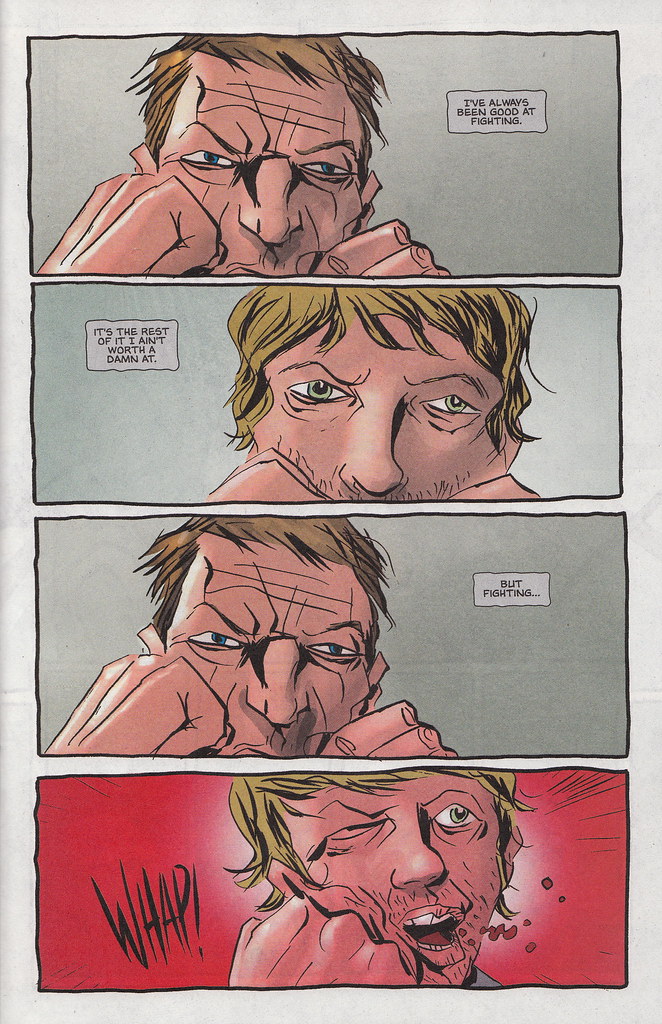
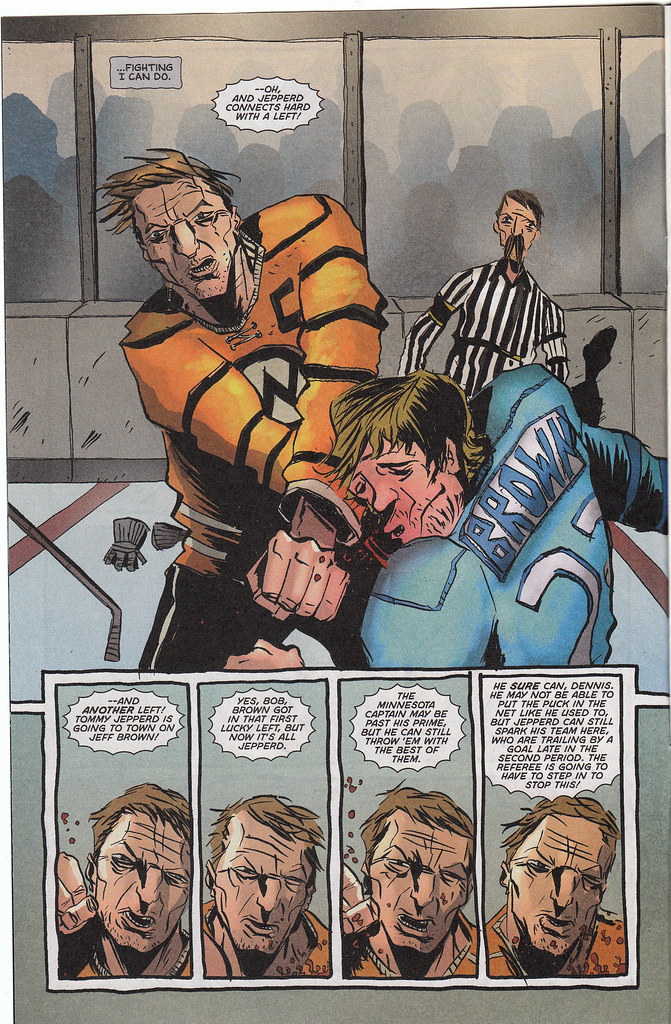
And it is the most fun I've had being sad in a little while. Lemire writes and illustrates the comic by himself, so it is basically all his (except for the colors, which are done by the great Jose Villarrubia). Mr. Lemire was kind enough to supply me with the script for issue six, and with his permission here are two pages from that script, along with the corresponding pages from the issue. For a really interesting comparison of craft and how the process of comic book creation is different for everyone, look at these pages first, then check out John Layman's scripts and the finished pages, illustrated by Rob Guillory, of his comic "Chew" here.

Since Lemire takes care of both writing and illustration duties on "Sweet Tooth" his scripts are much looser, and contain way less panel description than normal scripts. This is demonstrated nicely by how the line "...fighting I can do," is relocated to page two in the final comic, while within the script it is located inside panel four of page one.

*UPDATED*

After reading the comment about why Jeff Lemire may write full scripts for a comic he both writes and illustrates, I contacted Mr. Lemire and asked.

"Originally I did just write the scripts for editorial purposes, as I was used to working much, much looser, with just a detailed outline. But I found as I got into a few issues of Sweet tooth that the detailed scripts actually helped me to organize my thoughts and break down my outlines. I actually thumbnail as I write the scripts now, and it really works for me. Especially with a set page count that I have to work within each month. I guess the scripting process helps most in terms of writing dialogue. Once you get into the flow of of the writing the script it helps the dialogue come out more naturally."

He went on to explain the difference between versions of his scripts, particularly the variations in drafts, saying, "Of course I am always tweaking and changing my script as I draw, re-arranging panels...this is so the letterer has an accurate script to work from once the issue is drawn. The script [you posted] was a lettering script, so earlier versions would have diverged from the final art even more."

Thanks again to Jeff Lemire for being freaking awesome.

*Click on the images to make them larger.*

Sweeth Tooth 6 - pg.1 "Sweet Tooth" issue 6, pg. 1
"Sweet Tooth" 6 - pg. 2 "Sweet Tooth" issue 6, pg. 2

Locke and Key: Issue 3 Review

Comparing "Locke and Key" to the TV show "Lost" is a big time mistake, but I've done so in the past. What I really meant to say, most likely - hindsight - was that "Locke and Key" is a well-written, well-drawn, just all around well-freaking-created mystery.

What's actually comparable between "Lost" and "Locke and Key" is how I interact with their stories; I've seen episodes of "Lost" at least three or four times, and I've read issues of "Locke and Key" just as many.

Joe Hill and Gabriel Rodriguez are putting together a story filled with mystery, questions that may or may not get answered, and something that ties all of it together nicely, a prerequisite for any good mystery, at least one that succeeds on more than one level: character.

Good mysteries are certainly capable of existing without strong characterization, but if this happens then most likely they are intriguing because the reader/viewer/interested party is surprised by something; a twist they didn't see coming, for example. Having a twist/surprise is entertaining, but taken alone they are stunted enjoyments, like riding a roller coaster without throwing your arms up.

Not all roller coasters are suitable to throw your arms up, however, and this is just as easily a metaphor for all stories not having both mystery and characterization. "Locke and Key" is not one of those books.

Issue 3 of "Locke and Key: Crown of Shadows" was released on Wednesday, February 17, and along with furthering the mystery, adding more questions, more "What Ifs" to the already towering pile of them, it is loaded with characterization, foreshadowing (ehhh, puns), and humor. While all of these aren't necessary for the creation of a good mystery, they can occasionally be added to create a streamlined-machine-of-a-mystery that is bigger, stronger, and faster than normal mysteries.

- • -

There are quite a few things I like about "Locke and Key," but one of the most desirable aspects of the book is its unpredictability. The first time the reader was given a glimpse of the anthropomorphic shadows that are referenced in title of this third "Locke and Key" storyline was during the second storyline, "Head Games."


Locke and Key: Head Games issue 1


It was a gorgeous two-page spread of the high school production of Shakespeare's "The Tempest," as performed by Rendell Locke and Lucas "Dodge" Caravaggio. The shadows have an ominous presence in the picture, and seem to be coming to life. We see beasts, warriors, and demons all lurking behind the foreground, and the reader has no idea what is going on, other than teacher Joe Ridgeway's description: "...magic."

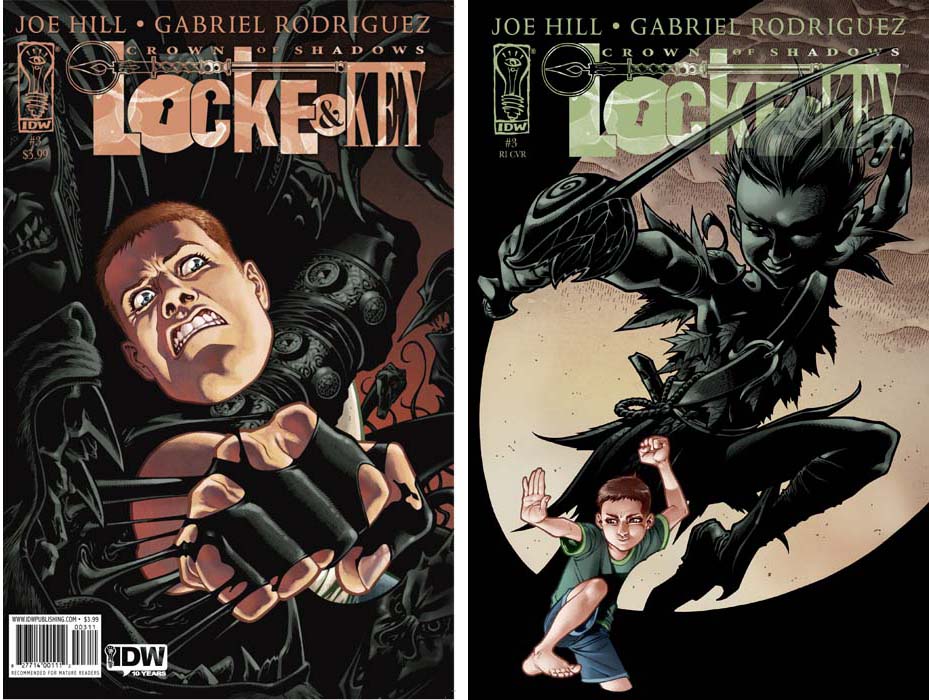
Before the titled of the third storyline was released these shadows didn't mean much to me, at least not in a direct way. I was sure they had something to do with a key, just not which one or why. After it was revealed the third storyline would be entitled "Crown of Shadows," I started forming theories about what these shadows may be, particularly when the variant covers for the issues of "Crown of Shadows" were shown. Here is the cover to issue three, along with its variant.


Locke and Key: Crown of Shadows

I had a theory that each person's shadow was defined by their inner workings, by who exactly they are. By utilizing the Shadow Key someone could activate their shadow, and thus do...something with it. This definitely wasn't my only theory regarding the story, but it was the first one to be shown as completely wrong.

Now I can go on reading "Locke and Key," forming theories, testing them, and smiling when Joe Hill and Gabriel Rodriguez send one flying by me, like they did here.