Showing posts with label creators. Show all posts

Monday, April 5, 2010

Imagine a World and It Appears: Farel Dalrymple

When I was younger my world was an immense place of excitement and adventure. My bicycle wasn't just a way of getting around, it was a means to travel from one setting to another, between worlds. I remember riding through my neighborhood, my mind painting in the details that simply weren't there in reality.

Imagination was enough, though. Farel Dalrymple proves this, and his art carries me close to places my mind would travel. Looking at his work in "Pop Gun War," "Omega: the Unknown," and work on his forthcoming book "The Wrenchies," it's easy to tell that Dalrymple can still travel to those places we go as children. He was kind enough to stop by Hideous Energy for an interview, and also supply the page with its second illustrated title card.


Unicorn Girl

Hideous Energy: When did you know you wanted to be an illustrator?

Farel Dalrymple: "I think I wanted to be some sort of artist since elementary school. My mom was an artist and art director for a Christian book publishing company, and was really into illustration and graphic design. I would flip through the Society of Illustrators books that were lying around our house. Whenever we'd go to the library I’d get whatever books I could find about comics. I was fascinated at N. C. Wyeth's illustration on a Robinson Crusoe poster my mom had put in my bedroom. Lacking discipline and getting sidetracked by other stuff growing up, by the time I was an adult I wasn't sure exactly what I wanted to be, right up until I actually started art school. I remember right before I signed up for classes I had this vague idea of me as a "fine artist" or something. Of course by the time I graduated from SVA’s illustration department I realized all I ever wanted to do was make my own comics."

HE: What college did you go to, and did you go in knowing you would be seeking a degree in illustration?

FD: "I went to the School of Visual Arts in New York City with a bunch of other excellent people that went on to do excellent comics and illustration. I had to choose a major when I enrolled but was sort of torn about it, thinking maybe about going into the fine arts department. I was advised to go into the illustration department, which I ended up being pretty grateful for. The illustration department there is almost a glorified craft school with a lot of intensive drawing and painting classes. Some people might take exception to this but it is just my opinion that the fine arts department was more about learning how to talk about and understand art, and kind of justifying what you are doing to your professors and peers. I am not the type that likes to talk too much about what I am doing. Class critiques and portfolio reviews were annoying to me. I just like to be left alone to do my thing with the occasional feedback from other likeminded artists. I don’t like working in a vacuum but too much talk sort of ruins the experience of making art for me personally."

HE: Did you have a strong imagination as a young boy? If so, how much of this do you think you've held onto?

FD: "I suppose I did. I spent a lot of time by myself growing up and was always entertained, though I probably watched way too much television. I always like getting sucked into stories as well as making up my own. Doing it for a living though has taken some of the fun out of all that for me. It is more of challenge these days to get excited by new ideas. It still happens sometimes."

HE: I've almost gotten a job at a book store in the past, but I was afraid it would take away the magic of the place for me. Has becoming a creator changed how you are as a reader (or viewer, or listener)?

FD: "Sure, somewhat, I might see more details and nuances in stories that an average reader/watcher might not see, but I still enjoy escaping into a good story. I am not too snobby about what I look at. It is all about what I expect out of something. I might be more of a fan of more things if I wasn’t a cartoonist but there is a lot of stuff out there I appreciate. I am just not as fanatic in general about anything the way I used to be. I am getting old and cynical."

HE: What sort of stuff did you watch when you were a kid? What about now?

FD: "Wow, that would be quite a long list. We mostly had cable growing up so I watched whatever I could stuff in my eyeballs. I was attracted to the weird and cult and sci-fi stuff but I watched a lot cheesy sitcoms and dramas as well. It is sort of lame that movies and TV are some the few areas I can have long conversations with people about. Well mostly anyway. There are a lot of times in my life where I had no TV so my knowledge of popular culture has some big gaps in it. These days my girlfriend and I watch a lot Star Trek shows we get from the library. I go to the movies occasionally but mostly I just watch whatever fun thing I can from the library. Any decent comedies or science-fiction/fantasy stuff are top on my list to watch. I’ll watch some arty stuff here and there but I just don’t have the time to be as geeky as I used to be about watching every art house movie out there. There is just too much stuff to watch, too many books to read, and too much music to listen to. I used to be really frustrated by this now I don’t have the energy."

HE: What comics - if any - did you read as a kid? (What comics - if any - do you read now?)

FD: As a youngster I read mostly super hero stuff. I was a hard-core marvel zombie. But I also read newspaper comics and illustrated children's books. And I remember pouring over the Roy Crane and E.C. Segar stuff in the Smithsonian collection of newspaper strips and thinking how fun it would be to do that for living. I really dug adventure strips. I read a lot of comics still, though the range now is a lot broader. I had given up going to comic shops and buying new comics for a few years in my late teens and early twenties. At art school I got exposed to the indie comics scene through Dave Roman and John Green and got a renewed vigor in collecting comics. Now I mostly just get books from the library and every once in a while I buy books from the comic shop. I think the last time I went into the comic book store I bought two Grant Morrison comics and the latest Big Questions by Anders Nilsen and a book called "I want you" by Lisa Hanawalt. Mostly though I get a lot of comics, "graphic novels" or whatever from the library. There is a really good library system here in Portland."

HE: What was the first piece of illustration you would say "got you noticed" by the comic book world?

FD: "I think it was probably the first issue of Pop Gun War. Most people seemed to respond pretty positively to it and it won a gold medal from the Society of illustrators."

HE: There is an awesome map in the front of "Pop Gun War," and I have some sort of weird obsession with fake maps. How weird do you think this is? Do you love fake maps too?


Pop Gun War Map

FD: "I don’t think it is weird to be passionate about what you like. I think that is great. A certain amount of obsession can be good if you channel it right. I think maps are neat but I don’t have a collection of them or anything. I always like when authors include additional material about their characters. A map seems like a good way to help visualize the world the characters inhabit. Specifically with Pop Gun War I wanted to do a map just because it lent itself to the whole world-building thing I am going for. I think also at the time I was reading some A.A. Milne and liked the whole 100-acre wood idea. It is fun for me to read a story then to see where all the characters would hang out. Tolkien did that too with his middle earth. I am sure a bunch of other authors do it as well. It also helps me personally organize my ideas in a way and stimulate new stories. Some of the locations I labeled in that pop gun war map I'm still planning on doing stories about or related to."

HE: How did "Pop Gun War" come about for you? Both creatively, and the publication by Dark Horse?

FD: "I had done one comic previously in art school called Smith's Adventures in the Supermundane. After graduating I was still pretty excited by trying to make the sort of comic I wanted to read. It came out of a bunch of sketches and ideas I had in my sketchbook. I think Jim Mahfood or Scott Morse had given Diana Schutz a copy of Pop Gun War to look at. I remember I was working at a coffee shop in the east village of NYC at the time. I got a call from Diana while I was working and she offered me a job in the Happy Endings book she was putting together. A couple years later I asked her if dark horse would put out the collection of the first five issues."

HE: "Pop Gun War" has been described as "urban fantasy." Does that label fit, or do you find it too limiting?

FD: "That seems like a fair description to me. The story takes place in an urban setting and there are a lot of fantastic elements."

HE: How much of your time in a day is spent drawing in some form?

FD: "It varies from day to day much to my dismay. I would like to be more consistent but I burn myself out a lot. I probably draw/ink/paint straight about 6 hours a day on average."

HE: Do you always carry a sketchbook around?

FD: "I do like to have my sketchbook or something to draw with whenever I leave the house just so I am not caught without it if I need it. I don't always use it every time I go out but it is a nice security blanket. It is also a nice buffer so I don't have to talk to people if I don't want to."

HE: What is the drawing process like for you? (Do you utilize any digital tools/programs?)

FD: "I draw with a pencil, I ink with a brush and pens, and I color with watercolors. I scan in my pages and do some production in Photoshop, like cleanup and a little color tweaking."

HE: How quickly can you complete a page?

FD: "It depends on the page but from conception to colors I like to try to get a page done in about 9 hours. I fiddle with pages too much though and often it takes me quite a bit longer."

HE: You recently did work for "Papercutter," an anthology released by Tugboat Press;
how much work have you contributed to anthologies?

FD: "I love Papercutter. Greg means is like the best editor I have ever worked with. It seems like I am in about one or two anthologies a year. I am trying now to use the same characters in any anthology I do. Last year I was in the free comic day nerd burglar comic and in the MySpace Dark Horse comic’s thing. This year I did a Vice magazine comic and the Papercutter story. They all have the same characters and are sort of a loose continuation of an ongoing story. My hope is to develop those characters into a long form comic some day."

HE: So have you started approaching compilations as a way to maybe test out new material?

FD: "Sure. I like participating in anthologies mostly because it is like being part of a special club or something. I also like the idea of knocking out two birds with one story. Anthologies seem like a good way to feature ideas that might not fit into whatever long form story I am working on at the time."

HE: How did the "Omega the Unknown" book come about? Had you read any of Jonathan Lethem's novels?

FD: "Jonathan just emailed me one day and asked if I wanted to the comic. I believe he told me that Bob Fingerman turned him onto my work. I had read a couple of his books and loved them. Motherless Brooklyn was one of my favorite books at the time. It was a delightful shock to get that email from one of my favorite writers."

HE: Wow, yeah, that would be an insane email to get. I read "Fortress of Solitude," and if Lethem emailed me and asked me to rob some old ladies I would probably agree. After you got that email did you immediately start emailing all of your favorite writers?

FD: "Nah, I am not much for writing fan letters. I think about it a lot but rarely end up doing it. Hopefully my work is as much as a love letter to all those I admire as any email could be. And the whole Omega thing seemed almost too good to be true. I could hardly believe it wasn’t all going to end abruptly. Even as I was drawing the final issues I couldn’t believe that it was really happening and was waiting for Marvel to come to their senses and get a real superhero artist on the book. Everything about it seemed sort of surreal. My favorite writer contacting me, Marvel doing a book like that, and letting us pick our own colorist, design our own covers and all that, it is still very weird and awesome to me. I don’t know how well the book sold for them but I love that they took a chance on us. I hope they do more books like."

HE: Do you prefer working alone, or collaborating with someone? Why?

FD: "They both have their ups and downs for me. I usually prefer to work alone but I love collaborating with a writer I am really into. Most paying gigs I get are with writers, which is usually fine. It is just a different sort of challenge for me. I have about five or six projects in a file folder that I plan on developing with several of my favorite comic book writers. I am just waiting for the right time."
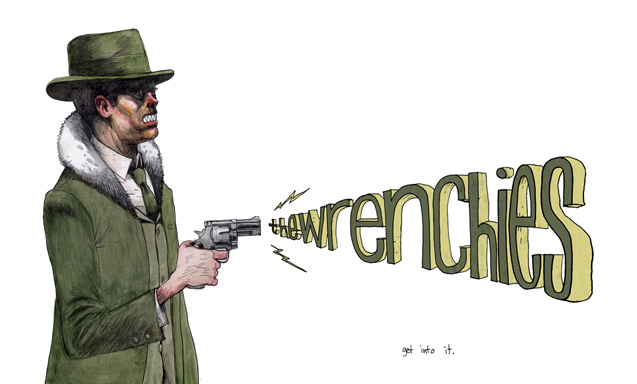
The Wrenchies

HE: There are some mentions of "The Wrenchies" on your blog, even some images of these mysterious kids. What can you tell me about them?

FD: "The Wrenchies are children in a post-apocalyptic future. They are all orphans along with the rest of the children in that future. The wrenches are also an older group of 21st century superheroes. They join forces in the future to overcome the evil Shadowsmen that are controlling the post-apocalyptic world. I am hoping to have the book done this year sometime. No tentative pub date, but I am aiming to have it finished by the fall."


The Wrenchies

HE: Can you reveal what exactly led to this post-apocalyptic existence?

FD: "Even in the finished story it won’t be completely clear what exactly happened. There will be an impetus for it and an acknowledgement of some worldwide cataclysm but it won’t be all spelled out. I didn’t want to get too bogged down in the science of it all, you know like how radiation would affect people and all that. A lot of it is sort of silly and doesn’t really help the story so I am keeping that part of it vague."

Thanks to Farel for stopping by for the interview, and supplying the second title card. Go check out his blog, and his books.

Friday, February 26, 2010

What's Next For Jeff Lemire? *UPDATED*

The writer and illustrator of Vertigo's ongoing comic "Sweet Tooth" is known for his moody, character-driven, and emotionally resonant stories. Not only in "Sweet Tooth," but his previous work with Vertigo, "The Nobody," and the work that launched him into comic book industry acclaim, "Essex County." Published by Top Shelf Productions, "Essex County" is a trilogy dealing with the emotional and mental goings on within small town folks. Lemire's next work is also set to be released by Top Shelf Productions, and has similar themes as "Essex County." Here is the official release about Jeff Lemire's next project, "The Underwater Welder."

THE UNDERWATER WELDER BY JEFF LEMIRE

Pressure. As an underwater welder on an oilrig off the coast of Nova Scotia, Jack Joseph is used to the immense pressures of deep-sea work. Nothing, however, could prepare him for the pressures of impending fatherhood. As Jack dives deeper and deeper, he seems to pull further and further away from his young wife, and their unborn son. But then, something happens deep on the ocean floor. Jack has a strange and mind-bending encounter that will change the course of his life forever. ... Equal parts blue-collar character study and mind-bending science fiction epic, The Underwater Welder is a 250-page graphic novel that explores fathers and sons, birth and death, memory and truth, and treasures we all bury deep down inside.

So not only is Lemire writing/drawing an ongoing title for Vertigo right now, with issues coming out regularly and on time, but he managed to write AND draw a 250-page original graphic novel? I have no idea how this guy does anything but sit at a drawing table.

Here is the first preview image of "The Underwater Welder," due out in 2011. *UPDATE* The Top Shelf page has this listed as coming out in 2012. Not sure which is the real date as of now, but if one is set in stone I'll find out.


Underwater Welder, by Jeff Lemire

Thursday, February 18, 2010

Sweet Tooth - Script and Pages *UPDATED*

It's nice and safe out there. Pressed up against the exterior of our doors and windows is a world that won't turn on us at any second. Danger does exist, but it isn't as prevalent as the world Jeff Lemire (pronounced Luh-meer) has created in his comic book "Sweet Tooth."

Along with being post-apocalyptic - which already means its a notch above our world when it comes to danger - there is a crazy chance if you're a child in the "Sweet Tooth" world you will be a weird human/animal hybrid, like the title character, "Sweet Tooth" (real name Gus), who happens to have antlers growing out of his head.

Lemire's stories are not sunny, so don't go into reading something of his hoping for a reason to start your toes a'tapping. Loaded with melancholy, Lemire's works are often dark and downright sad.

Issue number six of "Sweet Tooth," which was recently published by Vertigo Comics, is a great example of a spot occupied on the emotional spectrum by the majority of Lemire's work. It is soul-crushing; it will make your face scrunch up, your eyes feel heavy, and possibly even add a little quiver to your lip.

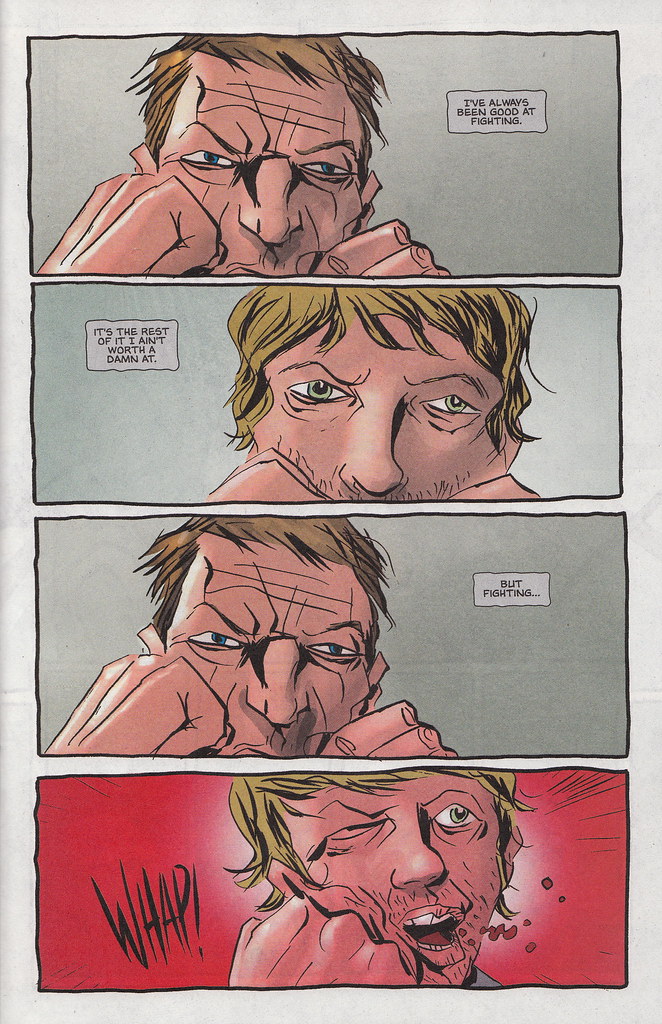
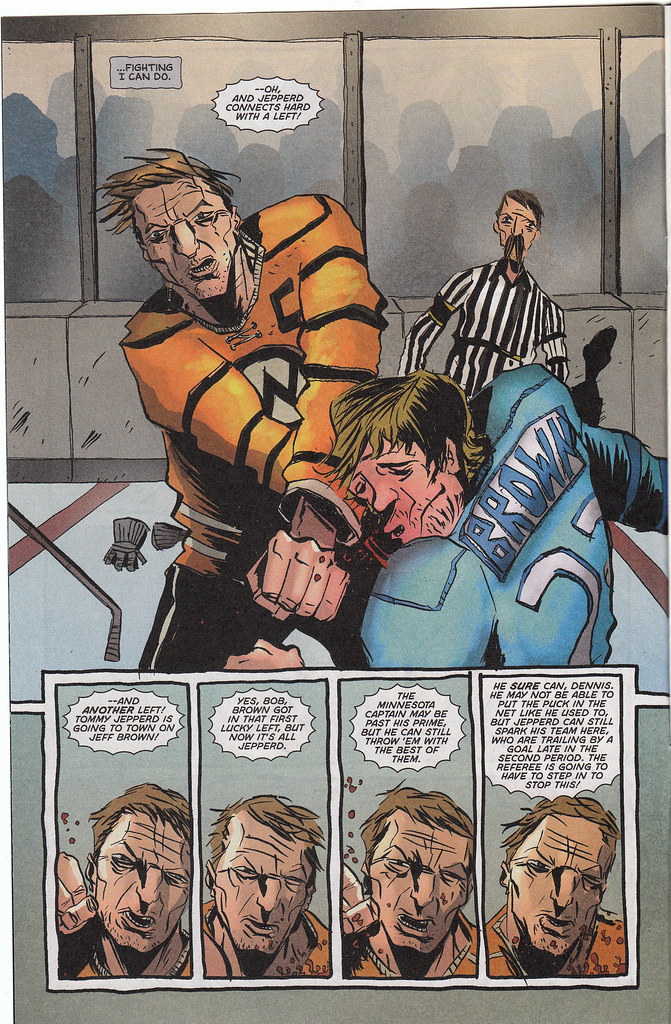
And it is the most fun I've had being sad in a little while. Lemire writes and illustrates the comic by himself, so it is basically all his (except for the colors, which are done by the great Jose Villarrubia). Mr. Lemire was kind enough to supply me with the script for issue six, and with his permission here are two pages from that script, along with the corresponding pages from the issue. For a really interesting comparison of craft and how the process of comic book creation is different for everyone, look at these pages first, then check out John Layman's scripts and the finished pages, illustrated by Rob Guillory, of his comic "Chew" here.

Since Lemire takes care of both writing and illustration duties on "Sweet Tooth" his scripts are much looser, and contain way less panel description than normal scripts. This is demonstrated nicely by how the line "...fighting I can do," is relocated to page two in the final comic, while within the script it is located inside panel four of page one.

*UPDATED*

After reading the comment about why Jeff Lemire may write full scripts for a comic he both writes and illustrates, I contacted Mr. Lemire and asked.

"Originally I did just write the scripts for editorial purposes, as I was used to working much, much looser, with just a detailed outline. But I found as I got into a few issues of Sweet tooth that the detailed scripts actually helped me to organize my thoughts and break down my outlines. I actually thumbnail as I write the scripts now, and it really works for me. Especially with a set page count that I have to work within each month. I guess the scripting process helps most in terms of writing dialogue. Once you get into the flow of of the writing the script it helps the dialogue come out more naturally."

He went on to explain the difference between versions of his scripts, particularly the variations in drafts, saying, "Of course I am always tweaking and changing my script as I draw, re-arranging panels...this is so the letterer has an accurate script to work from once the issue is drawn. The script [you posted] was a lettering script, so earlier versions would have diverged from the final art even more."

Thanks again to Jeff Lemire for being freaking awesome.

*Click on the images to make them larger.*

Sweeth Tooth 6 - pg.1 "Sweet Tooth" issue 6, pg. 1
"Sweet Tooth" 6 - pg. 2 "Sweet Tooth" issue 6, pg. 2

Tuesday, February 16, 2010

Chew - Script and Pages

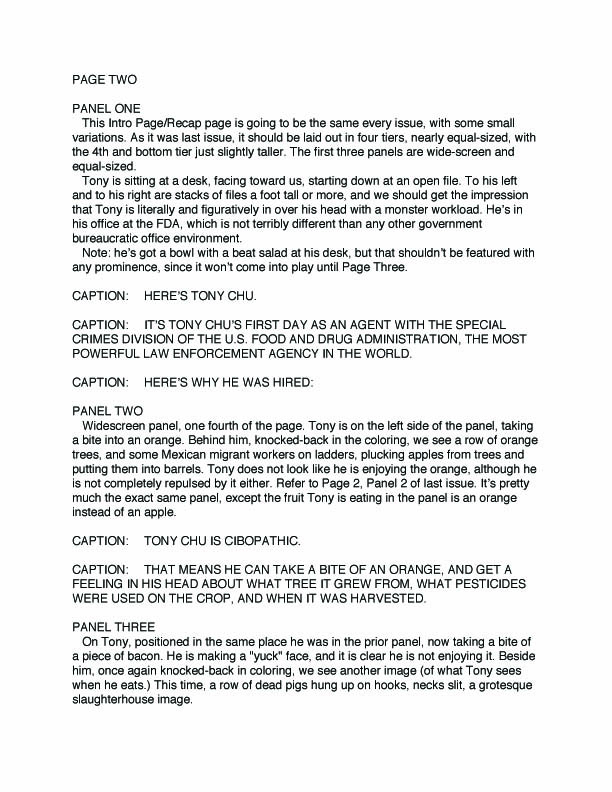
Recently the Alter Ego Comic Cast talked to John Layman, the creator and writer behind Image Comics' crazy book "Chew." It is the tale of Detective Tony Chu, who happens to be a Cibopath. Not sure what that is? That's because it's completely nuts, and totally out there freaking awesome and fun.

A Cibopath is someone who receives telepathic flashes - images, sounds, feelings, smells, tastes - of whatever he or she eats. Yeah. I won't go too far into explaining this, but allow you to seek out the first issue and find out exactly how weird and fun this idea can be.

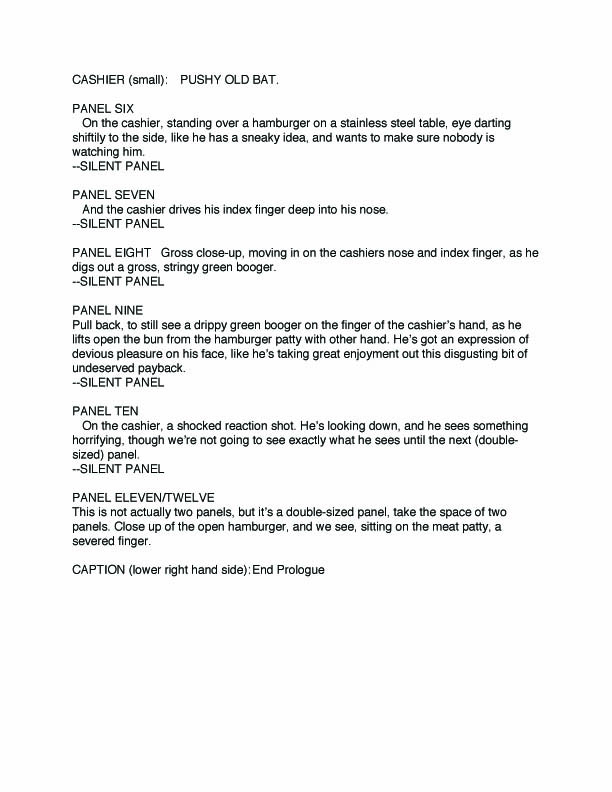
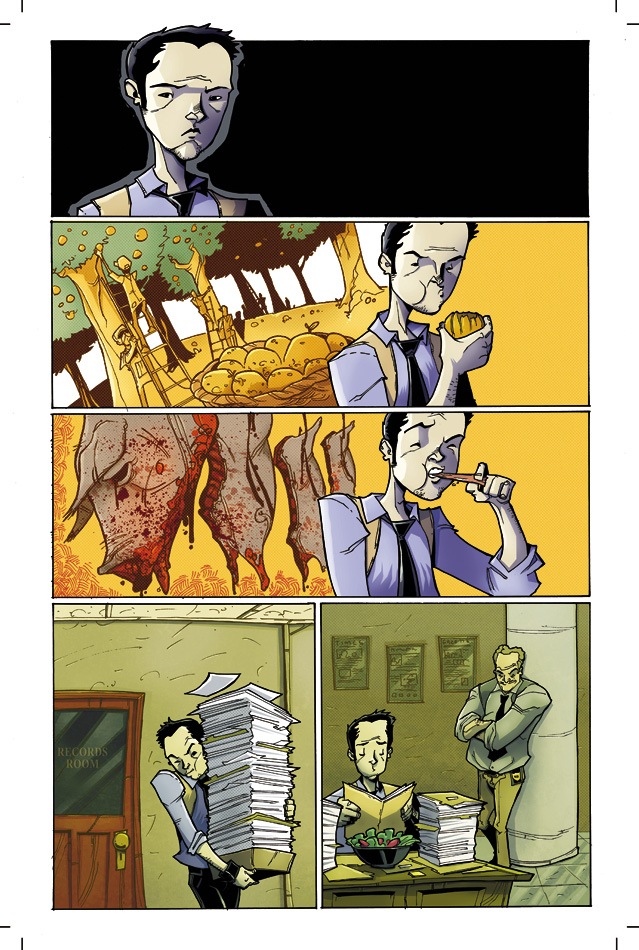
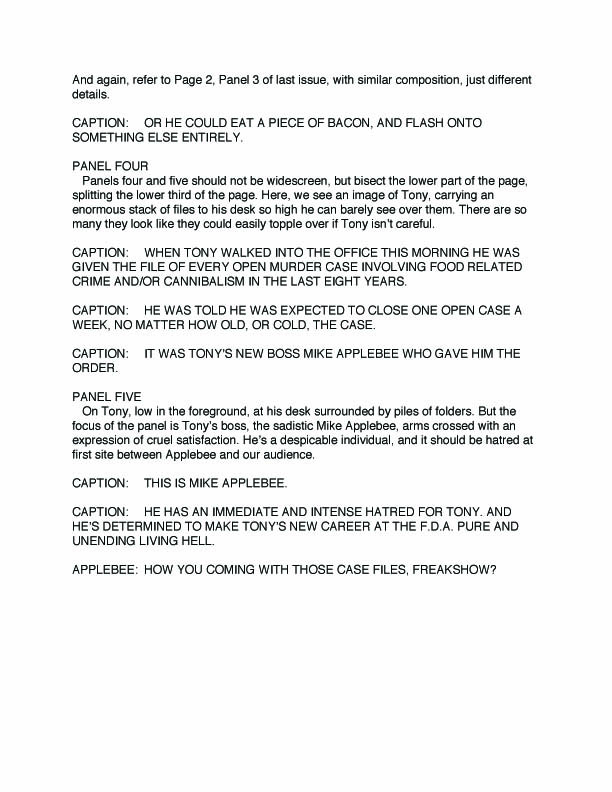
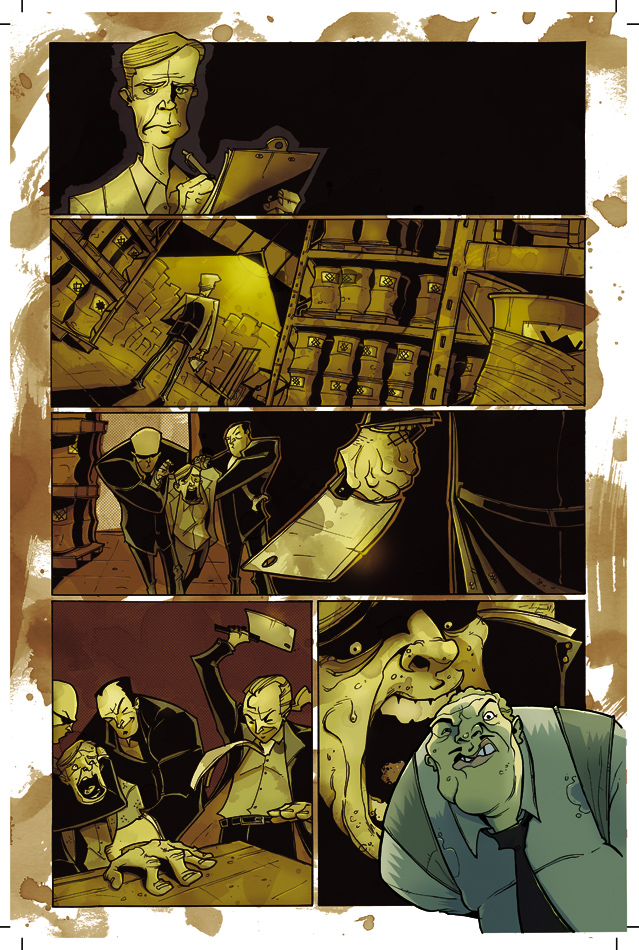
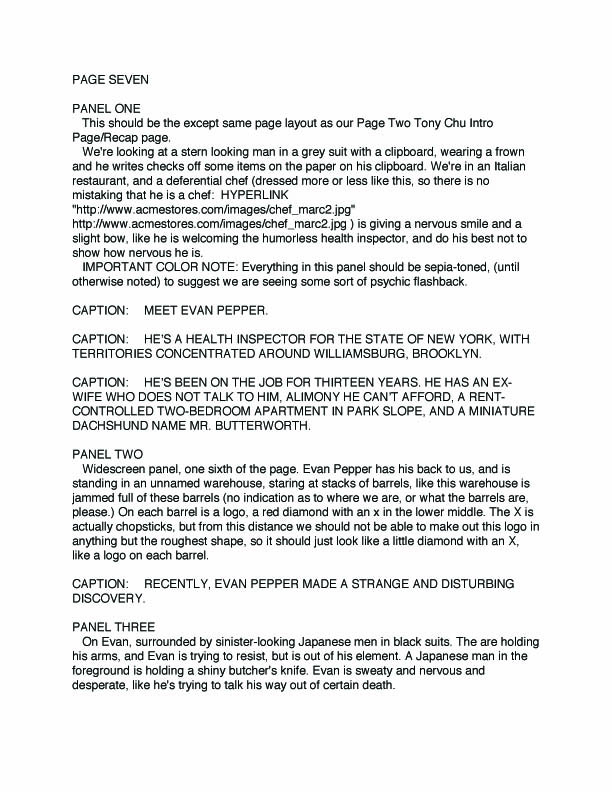
What I can do, though, is post three pages of John Layman's script from issue number two of "Chew," along with the finished art for the pages, minus dialogue. I've always loved comparing script pages with finished art, particularly in books that are written by one person and illustrated by another. The process of creating a book with two separate minds involved intrigues me to no end, and this is one way to get a unique glimpse into how exactly these awesome things called comics are made.

Huge thanks to John Layman for providing the script pages and final art work, and for doing an interview over on the Alter Ego Comic Cast. *NOTE The interview will be posted HERE*

When selecting the pages to showcase I tried to select a few that would feature a strong sense of panel progression in order to show exactly how good storytelling should work in comics, along with pages that may feature ideas or mechanisms that might seem difficult to translate into images. The artist for "Chew," Rob Guillory, demonstrates in these pages - and the rest of the comic - how to tell a good story utilizing both the words supplied by the writer, and the images supplied by a pencil or pen.

(I had to break the script pages up into two separate pieces, so you'll have to utilize multiple windows. Sorry. Also, click on the images to make them bigger.)


"Chew" Issue 2 - Page 1Chew issue 2, Pg. 1 - Part 1Chew issue 2, pg. 1 - part 2
Page 2 of "Chew" issue 2.
"Chew" issue 2, pg. 2 - part one"Chew" pg. 2 - part 2
Page 7 of "Chew" issue 2.
"Chew" issue 2, pg. 7 - part one"Chew" pg. 7 - part 2

Wednesday, December 16, 2009

Lucy Knisley: Food and Cats and Comics


Laughing out loud is such a great feeling. One of the best, maybe. Combine the pureness of feeling entertained with an out-of-control sense of breathlessness, and you get something literature professors would call "euphoria." But man do labels smother a feeling, sometimes; it's so much better to just feel the thing (and I could rant for hours about people who say, actually say "LOL").

Artist Lucy Knisley (pronounced "Nigh-Zlee) has made me laugh out loud on more than one occasion, and this, combined with her unique (there's a lable, whoops) art style, created a fan in me since I read the comic about her adventures on Vicodin.

Along with being awesome enough to do this interview, Lucy illustrated the very first title card for this blog, based around the concept of Hideous Energy! Thanks again, Lucy!

- • -

Hideous Energy: Do You remember when you first thought, "I want to work in comics," and if so, what was the impetus behind the thought?

Lucy Knisley: "My mom is an artist and my dad is a literature and writing professor. When I was a kid and they were divorcing, I got really into reading comics, I think due partly to the merging of the written word and image in comics that allowed me to feel connected to both of my parents at once. I loved writing and drawing, and didn't want to sacrifice either endeavor to the other, so comics became my perfect solution, but still I didn't think of it as an aspiration, but more of a hobby. Through most of my life I'd stubbornly thought that I'd still have to choose either writing or drawing as "a profession." The thought of "Working in comics" didn't really occur to me until I was in my freshman year at art school, where I'd gone to study painting. I realized that painting didn't fulfill me as much as did the comics I'd been drawing since childhood, that I'd begun to absently publish in the school newspaper. They were spotted by then senior student, Hope Larson, who contacted me to connect with another girl comic artist at the school. It was her support and introduction to the world of "working" as a comic artist that really cemented the idea in my head."

HE: So was your childhood and adolescence filled with comics (both drawn and read)?

LK: "Oh yes. I was lucky enough that my parents encouraged it. I had every Tintin and Asterix and Calvin and Hobbes book I could lay hands on, and a stack of banker's boxes of Archies that would insulate my apartment. At my mom's house in the country, we had a pond, and I would float myself out into the middle on a raft with a box of comics, so I could read them undisturbed until it got too dark to see. As a kid, I didn't get carsick if I read, so I had a headlamp that allowed me to read comics in the backseat when my parents drove me the 2 hours between Dad's house in Manhattan and Mom's in upstate New York."

HE: I'm happy I'm not the only person who wore a headlamp. I think reading in situations like that has a different effect. Almost like you feel even more involved in the work; more alone, somehow.

LK: "Definitely! To be ensconced in your little cone of light, the only illuminated object: a page of panels -- it probably does something terribly permanent to our brains."

HE: What (or whom) within comics would you say was the biggest influence on you creatively, either in leading to making comics for a living, or stylistically?

LK: "I went to four different high schools in three years. It was a bit of a rough time for me. I skipped from various prep and public schools, tried boarding, and ended up at a tiny little progressive school that focused on the arts. We would pick majors, essentially, and spend most of the week on what we chose as a core study. It was the first time I'd been encouraged, let alone allowed, to draw comics or paint or screenprint or take photos as a classtime activity. The art teacher, Wayne, allowed me and my soft, squinting brethren to shelter in the basement art room, away from the PE or Physics classes, and make art. He got me focusing on art, why I made it and how and later, even with my spotty high school transcript, he helped me get into a great art school. There, I met Hope Larson, who I credit for introducing me to the world of professional independent comic artistry. And my parents, who didn't totally approve of Archie comics but still bought them for me anyway, were important factors in getting me into it. Early loves, like Maira Kalman's work or William Steig's or Herge's built the foundation, but it wouldn't have occurred to me if I hadn't had such great people pointing the way."

HE: Do you remember what they objected to, regarding the Archies? Also, were those the only comics they begrudgingly bought for you?

LK: "I remember exactly -- My dad considered them to be non-literature, poorly written with repetitive gags. My mother thought they were sexist -- the whole Archie/Betty/Veronica thing. They were right, in a way, about both those elements, but because I loved the comic I had to look at the work critically and seek out reasons to defend my love of them to my parents. I'd learn a new word and rush to my dad to tell him that I picked it up from a story about Archie's "dilapidated" jalopy. Or Betty and Veronica would toss the hapless Archie into a fountain, and I'd run to tell my mother about how they banded together in the spirit of girl solidarity. If Mom and Dad hadn't been at least slightly against the comics, I may never have learned to look at comics past the surface. The rest -- the Calvin and Hobbes and For Better or For Worse they sort of indulged with shrugs, but Archies were the only ones they seemed to actively dislike.

HE: Did your love of comics lead you directly to The School of the Art Institute of Chicago (SAIC)?

LK: "Absolutely not. SAIC doesn't really have a comics program, though they're building one now. I went for painting and drawing, and didn't find my way to comics until halfway through my first year there. I'm glad I went. They have an amazing writing and art criticism program, where I took a lot of my classes, and I think that was important for me in shaping my comics. I'd always loved writing, but I'd chafed in high school in confining english classes. It was a great chance to explore writing outside of a writing-focused program, but still get a great education. The foundations of design, color, materials and the enormous focus on drawing-from-observation in the painting and drawing department of the school helped out with the visual side of things, from a perspective that some comic artists don't get, as they learn comics from comics, rather than from the background of fine arts. I think it gives my work a new perspective."

HE: Were there any classes at the Art Institute that felt stifling? I've experienced classes that are dedicated to the arts, yet somehow make them seem stodgy or boring, and I always end up avoiding the work somehow.

LK: Oh yeah! When I got to art school, I'd already spent two years in an intensive arts program in high school, so the baby-steps of foundation year really pissed me off. It was the same at CCS, where I'd had all the art school foundations for the past four years-- art writing and life drawing and art history-- and I felt irritated that I had to sit in classes with the same material, in order to get everyone at CCS up to the same level. It wasn't the fault of the classes, just the result of my being a bit of a know-it-all, I think. It's good to be bored, sometimes, because it lets you be a rebel and push yourself to prove that you can do better than what they're forcing you into. I didn't feel that way in high school, unfortunately, where I thought that boredom in class meant that I didn't have to do the work when I didn't feel like it."

HE: You obtained your Masters of Fine Arts in June of 2009 from the Center for Cartoon Studies. What was your master's thesis?

LK: "My master's thesis was a self-published collection of my journal comics, compiled throughout the year (Pretty Little Book), along with a handful of minis about my experiences putting out French Milk with a major publisher, and a collection of small illustration and comics projects I'd completed during my thesis year. Most students put out graphic novels or a collection of issues of a comic serial. I'd originally intended to complete [my current project] "Relish" as my thesis, but it turned out to be a project a little longer in the development. Classes at CCS focused on a broad range of comics, writing, comics history, and art. Our instructors pointed us towards what interested them, so I think that helped the variety. From Steve Bissette, we'd read great Jack Kirby stuff, Stan Lee and Joe Schuster books. Jason Lutes seemed to prefer slightly more modern stuff, like Seth and Nick Bertozzi and Spiegelman. It depended on the focus of the class (Bissette taught Comics HIstory, Lutes tought Drawing Comics), but we were constantly inundated with more comics material than we could keep up with! And for a class of students obsessed with comics, that's saying a lot. We also read a lot of prose, nonfiction and even some poetry in our writing classes, where we'd discuss the transition of writing for comics vs. writing for straight text. All in all, the school had more of an emphasis on independent comics, encouraging us to make zines and minis to sell at indie conventions, and filling our inboxes with hard-to-find gems from the alternative comics industry. Cool stuff."

HE: What types of prose were assigned? Also, what do you read for enjoyment?

LK: "A lot of classic American Lit stuff, short stories from a big collection -- the kind of thing you have in most first-year college writing classes. We'd do essays, writeups for the reading assignments, and translation of short stories into comic scripts. Most of the time, Sarah, our teacher, let us read what interested us, and discuss it or write about it. I'm a terrible re-reader. I'd rather re-read an old favorite than try something new, most days (drives my dad CRAZY). So I'd bring in "The Catcher in the Rye," which I keep by my bed and read a few pages every night (finishing and flipping back to the beginning again, like a crazy person), or Oscar Wilde or David Sedaris. I love C.D. Payne, the author of "Youth In Revolt," and Mark Helprin ("Winter's Tale") and Chuck Palahniuk (everything except his most recent two) and Michael Cunningham and Stephen Fry. Huh -- interesting that most of my prose preferences are by and about men or boys. I guess I like to get in their heads! I also adore trashy books of almost any kind, as long as I can justify them with cheapness or necessity (like at an airport bookstore, with no reading for the flight ahead). I've re-read this hilarious and great fantasy series by Robin Hobb (The Royal Assassin Series) about a hundred times since I was 12. And I love, of course, Margaret Atwood. She fuels my nightmares completely with her books-- likely because I'm pretty gullible when it comes to post-apocalypse stories (and most things)."

HE: What types of music do you listen to?

LK: "Well, I used to think that what I liked was so wide-ranging that it couldn't be summed up neatly to people who asked, until the TV show Glee, which combines radio pop hits, broadway musical numbers, the occasional indie favorite, and classic rock stuff that I love. If it was on that show, it's on my iTunes. It's become my litmus for whether I'm going to like something. Truthfully, though, I'm easy to please. I stumble upon embarrassing pop songs on the radio at the gym, and torture my friends with these songs until they wrestle me into headphones. I hear something on a commercial and have to have it. I think that when it comes to music, I'm really sensitive to repetition and sales, so I end up being this collector of the collective consciousness. It's kinda ridiculous, but if I'm going to have this profession where I'm ruining my back making cartoons for grownups, with fiddly little inks and papers, I get to be a teenybopper radio junkie in my musical life!"

HE: Do you have interest in mainstream, "big two," published books? Or even books published by places like Dark Horse or Image?

LK: "Not really, though it's not like I hate them. Before all was eclipsed by Terry Moore's "Strangers in Paradise," I read "Lucifer," from DC/Vertigo, religiously (no pun). But the one time I ever got really into a traditional superhero-type series was when I was 12 or so and bought and read the entire "Harbinger" series, from Valiant, so I can't even claim that I read superhero comics from "The big two." It was a lot like X-Men, maybe a little darker. I think I liked the chubby girl character (Zeppelin. No comment.) -- you didn't see a lot of chubby superhero girls.

HE: Your journal/travel comic "French Milk" was published in 2008, detailing a trip to France with your mother; was it always in your head that what you wrote/drew would be published eventually? Were there any thoughts to maybe censor yourself?

LK: "When I wrote French Milk, I'd only ever made mini-comics and internet pieces-- nothing that long-form. It was a time in my life when I recognized that things were shifting and changing for me. I set out to chronicle the trip because I sensed that it would be an important event in my life, during a time I wanted to remember. I had no real idea that it would eventually be published. As a result, it's pretty unedited. I don't skimp on whining or self-pity, I don't try to make myself look good-- it's a straight up journal. When I got home, I realized that there was a story there, something that could be shared with readers who might empathize with me, but I didn't really know how to go about getting it to people. It was too long to take to Kinkos, and I didn't think it was something that would be easily read online, so I turned to self-publishing, then later, it was picked up by a publisher. It was cleaned up a bit when it was big-time published, the incorrect french was fixed, and the parts where my handwriting got a little illegible, but almost nothing was removed from the final manuscript."

HE: You post regular comics on your website, for free; do you think a strong digital presence is important in today's publishing climate?
LK: "I suppose it helps for creators to have a digital presence, but I post free comics because I'm one of those people who makes things impulsively. I'm plodding through my book, and it's hard work -- a long road ahead. I need to be able to make work that I can finish in a few hours and share with readers, in order to remind me of why I make comics at all. If it's just me, scribbling away in vacuum, I'd never get anything done, oppressed by my own inability to see why anyone would want to read this stuff, nor to know how I might feel good once it's all finished, a million gazillion years from now. It helps, too, to know that I'm not being forgotten by people who have connected to my work. With regular posts, they can be reminded of my presence, and can see my development and be familiar with me and my work. I make comics so I can reach out and connect to people, and with a two-year break in that connection while I work on a book, it's harder to maintain."

HE: Do you think digital comics will eventually render print comics obsolete?

LK: "No. Print comics are too portable, friendly, beautiful and necessary in the interchange and reading of independent comics. I hope never to have to choose, of course -- digital comics have allowed me to read WAY more comics than I would ever have been able without the digital format, so it's impossible for me to be afraid or upset by them and what they mean to print comics. Print comics remain beloved items on my shelf, but as a reader and not a collector, the more comics I get to read, the better, no matter how they're getting to me. What I hope is that more artists will build up their work in digital format before transitioning to print, sparing the paper from very rough, five-page undeveloped mini-comics, and only going to print with work that is finished and complete. I love a beautiful, well-written comic in print form, but it makes me nervous to see giant stacks of paper comics depicting someone's rough sketches or other work that might be better received on a blog or website. What I hope the digital predominance will do to print comics is improve their standards, reserving print for finished work and allowing earlier, rougher work to be viewed digitally, so as to make it easier to examine, critique and improve through the viewer's input, getting it up to a higher standard for print."

HE: You're sort of an "indy" artist, your comics focusing on your life, or "slice of life" moments. What comics do you read regularly, if any?

LK: "I feel like I read a lot more prose than comics, but that's probably because I tend to read a lot of comics by keeping up with comics work by my colleagues and friends, and it doesn't feel as much like consumerism as it is friendship and voyeurism! I'll read anything by Jess Fink, Erika Moen, Hope Larson, Maris Wicks and Ming Doyle, all great pals for years who's work I adore. Once a week, I try to get together with a group of Chicago comic artist pals, like Jeremy Tinder, Grant Reynolds, Laura Park, Corinne Mucha and Bernie McGovern, where we can exchange work and doodle together, so I get to read their wonderful work as they make it. Faves like Lynda Barry, Kate Williamson and Maira Kalman are always on my radar, and I'll scoop up anything they do or touch. Hm, I seem to have a pretty lady-heavy reading list! And they say there are no women in comics."

HE: I previously posted on here about women in comics, but my list was nowhere near as long as yours. Do you still see it as a battle for female creators, or would you say it's nearing equilibrium between the sexes now?

LK: "I hope I'll never see it as a battle! It's a hard line to trod, because girls seem to make GREAT comics, but the ones I love are great without benefit of being "by women." It's not as if I like them because they're by women artists, it's just that I think these women are making better comics than most other artists. Maybe they're doing so out of adversity -- some will to prove themselves in the industry -- but I think it just has more to do with having great voices, and wonderful stories to tell. I think current comics readers are also recognizing those voices as being great, women or men, and responding in kind. What I think is happening is that the comics world is expanding to include so much great stuff, and it's making it all bigger and better. For example: At CCS, I was one of four women in my class of fifteen, but at art school, it was about 60% women to 40% men, and I know girls like Hope Larson and Lilli Carre who emerged from that school into the comics world and totally rocked it from new perspectives from the traditional "comics are this" conventions."

HE: Currently you're working on your next book, "Relish." What exactly is it about?

LK: Relish is a collection of stories about growing up, framed in the context of food -- because that's what matters to me and to my family. We have more family photographs of food than pictures of actual people. My mother is a professional chef and caterer, and most of her side of the family is involved in food in one way or another. I have all these stories from being a kid and helping my mom cater crazy events, or working for her at the farmer's market where we sold local artisanal cheeses, or her teaching me how to make amazing meals from food grown in her garden. Interspersed with family recipes and made-up ones, funny stories about traveling mishaps and edible atrocities, it's mainly a collection of autobiographical stories with an emphasis on food, nourishment, and the connection between eating and memory. It's still got a long way to go -- it'll be close to 200 pages, in full color (First Second is determined to make this a really gorgeous book -- I am beyond thrilled to work with them). The pages are looking good -- it's hard not to share them as they're drawn, but it'll be interesting to see how people receive such a massive pile of my work, when it's eventually finished. Until then, it lets me experiment with recipes, draw pictures of food (my favorite!), and get distracted drawing journal comics to post online."

HE: So will it be a sort of illustrated cookbook? I know you posted an online pickle-recipe-comic; can we expect content such as this in "Relish?"

LK: "It'll be a collection of short drawn stories, sprinkled with recipes -- Kind of like chef David Leibowitz's "The Sweet Life in Paris," which I recently read and loved -- if you're into paris and food, I highly recommend it. He tells stories about living in France, then follows each story up with recipes that somehow reflect the story you just read. It's not a strict cookbook, just a little something extra for people who love to read about food. The recipes in Relish are part of the stories, rather than an itemized list you'd find in a cookbook. If you've seen my comic recipes online, it'll be a lot like that -- informal and meandering. You could make the stuff I describe, according to the book, but it's more about reading the words and thinking about the food, because I've found that reading recipes can add to the sensory experience of reading a book, especially one about food."

HE: Your LiveJournal account is loaded with pictures of your cat, Linney. Have you ever thought of doing a zine, minicomic, or book about her?

LK: "It's hard not to think about making more comics about Linney when her butt is covering the page I'm trying to draw. She's all up in my face! I joke around that to please my readers, I have but to draw a picture of my cat, a comic about Twilight, or a comic about Harry Potter (which I've done, all, and they were totally fun). Linney's got such a personality, she practically writes her own stories. I have Jeffrey Brown's cat comic in a place of honor on my shelves, and I asked him about it once when he and I were at a book launch in Chicago. I think the success of that book was a little bewildering -- his personal stories and painstaking journals eclipsed by six panels about a cat finding its way out of a bag. I worry that making a long-form Linney book would be too much like what Jeffrey's already done with his cat book, and I'd get jealous of the attention Linney'd get. But man, it would be so fuuuun."

Thanks again to Lucy for the interview and the picture! Check out her website, her book "French Milk," and keep your eyes open for "Relish."

Tuesday, December 8, 2009

Just Make the Good Guy a Bad Guy

Movie writer and sometimes-comic-author Mark Millar recently revealed his next project to be a comic entitled "Nemesis," where the concept is, "What if Batman was the Joker?" My complaints of Millar as comic book traitor aside, and although this is VERY early on in the whole process, this sounds laughable to me.

Aside from the comparisons between the concept behind "Nemesis" and Mark Waid's fantastic "Irredeemable" - which is already being published - the idea of doing a book where you simply make the hero into his or her biggest villain seems almost too...simple.

Sure, there are great dichotomies between heroes and villains, and a story of a hero turning villain can be considerably dramatic and engaging, but Millar isn't writing a comic where "Batman" becomes the "Joker;" he has taken the archetypes, and is going to write a comic for ICON, the Marvel imprint that allows you to cuss and show boobies.

What, exactly, is my problem with this idea? As I stated earlier, the simplicity. I don't doubt Millar's writing ability. When he bothers to complete a project it has at least a 50/50 shot of being good, although this is under the caveat of it being published on time. It took almost an entire year for the third issue of "War Heroes" to come out, immediately canceling out any good story Millar may have written (in my eyes at least).

Maybe this is in fact a bias I've developed after his comic "Kick Ass" was optioned for a film before the story within the comics was even more than 1/4 of the way finished. Hell, not only optioned, but MADE. There's viral marketing campaigns, clips, trailers, an entire advertising machine for the movie, and the comic book series is not even finished yet.

Perhaps the movie will get someone to pick up the comic, but I'd say it's just as likely to not. Anyone who watched "Wanted," then READ "Wanted" probably got a huge freaking surprise.
So I guess I'm still mad at Mark Millar for abandoning comics, in a sense, and for coming up with simplistic concepts that make it that much easier for me to yell "Sell Out!" at him.

It's a definite now, though: I will have to read the first issue of "Nemesis" when it comes out in order to find out if I'm right. Who knows, maybe he'll have written something I really like. If not, then I can write a whole bunch of other words about how right I was.