Showing posts with label review. Show all posts

Wednesday, September 19, 2012

#099 - The SPX 2012 Show!


Visit Hideous Energy at the following places:
Twitter - Tumblr - Facebook - hideousenergy@gmail.com - Fan Off.com
Also check out our webcomic Super Cute with artist Brent Hibbard. Follow Austin on Twitter @austinRwilson, David @SuperCuteComic, and Brent Hibbard @BrentHibbard

Episode #99:

• Intro - Bethesda, Maryland welcomes us to Small Press Expo 2012! Road show baby! Thank you DCBS for making it possible.
• Small Press Expo 2012 - We went there. We handed out minicomics. We talk about that, and all the awesome people we met, including a Hideous Energy listener we drove 9 hours to meet! HOLY SHIT.
• Untitled Mail Segment - We read your emails and listen to your calls. Email us at hideousenergy@gmail.com and call us at 1-720-HIDEOUS.
• Outro - Suicide ghosts? We're dead. But we always loved you.

Please go check out the final entry to the Tate/Williams Fucktastrophe of '98 over on Super Cute. We are so proud of it.

Go check out our webcomic with Brent Hibbard, Super Cute (supercutecomic.com). Download more Hideous Energy episodes through iTunes or Fanoff.com.


Wednesday, September 12, 2012

#098 - Show Me the Booty


Visit Hideous Energy at the following places:
Twitter - Tumblr - Facebook - hideousenergy@gmail.com - Fan Off.com
Also check out our webcomic Super Cute with artist Brent Hibbard. Follow Austin on Twitter @austinRwilson, David @SuperCuteComic, and Brent Hibbard @BrentHibbard

Episode #98:

• Intro - We're imperfect clones of each other, but we kiss the same. DCBS is nice, because they are paying us to be this way.
• Topic Thunder - Greg Capullo wants the booty (maybe), Davie Sim joins Fall Out Boy, and the writers of DC's New 52 are writing fan fiction? Say wha?
• Read 'Em and Weep - Hawkeye #2 by Matt Fraction and David Aja; Stumptown Vol. 2 #1 by Greg Rucka and Matt Southworth; and Ultimate Spider-Man #14 by Brian Michael Bendis and David Marquez.
• Remember the Hyphens - We completely forget that Elektra and Black Cat show up in Volume 8 of Ultimate Spider-Man: Cats and Kings.
• Outro - Call us; there's no maybe about it. CALL US - 1-720-HIDEOUS.

Go check out our webcomic with Brent Hibbard, Super Cute (supercutecomic.com). Download more Hideous Energy episodes through iTunes or Fanoff.com.


Wednesday, September 5, 2012

#097 - No, yeah.


Visit Hideous Energy at the following places:
Twitter - Tumblr - Facebook - hideousenergy@gmail.com - Fan Off.com
Also check out our webcomic Super Cute with artist Brent Hibbard. Follow Austin on Twitter @austinRwilson, David @SuperCuteComic, and Brent Hibbard @BrentHibbard

Episode #97:

• Intro - Disturbed, Limp Bizkit, and our sponsors DCBS - we all love rap rock.
• Remember the Hyphens - Volume 7: Irresponsible, featuring Geldoff. It's vindy up here. It's vindy.
• Mail From the Fans - Our still unnamed (kind of) mail bag section where we read YOUR emails and play YOUR voicemails. Call us at 1-720-HIDEOUS, and leave a message. We will not answer, it is a message service only.


Go check out our webcomic with Brent Hibbard, Super Cute (supercutecomic.com). Download more Hideous Energy episodes through iTunes or Fanoff.com.


Wednesday, July 11, 2012

#091 - Prancin' On the Edge


Visit Hideous Energy at the following places:
Twitter - Tumblr - Facebook - hideousenergy@gmail.com - Fan Off.com
Also check out our webcomic Super Cute with artist Brent Hibbard. Follow Austin on Twitter @austinRwilson

Episode #91:

• Intro - Further into the past, Nintendo, and Austin is a giant baby.
• Read 'Em and Weep - Revival #1 by Tim Seeley and Mike Norton; Edison Rex #1by Chris Roberson and Dennis Culver; The Cape: 1969 by Jason Ciaramella and Nelson Daniel.
• Remember the Hyphens - A new finite segment where we review/discuss every collection of Ultimate Spider-Man, starting with volume 1, Power and Responsibility.

Go check out our webcomic with Brent Hibbard, Super Cute (supercutecomic.com). Download more Hideous Energy episodes through iTunes or Fanoff.com.


Wednesday, March 14, 2012

#075 - Dr. Seuss's Underwater Hell


Visit Hideous Energy at the following places:
Twitter - Tumblr - Facebook - hideousenergy@gmail.com - Fan Off.com
Also check out our webcomic Super Cute with artist Brent Hibbard.

Episode #75:
• Intro - A very normal episode celebrates our 75th show! We talk Discount Comic Book Services, and a tiny bit of Star Wars.
•Topic Thunder - The amazing artist Moebius pass away, and we discuss his influence; Alan Moore. Yep.
• Read 'Em and Weep - Saga #1 by Brian K. Vaughan and Fiona Staples; The Secret History of DB Cooper by Brian Churilla; Age of Apocalypse #1 by David Lapham and Roberto De La Torre; Defenders #4 by Matt Fraction and Michael Lark; Ultimate Spider-Man #8 by Brian Michael Bendis and Sara Pichelli.
• Fan Mail - We answer fan questions. Send us some questions and we'll answer them on-air!

Wednesday, January 18, 2012

#067 - "I am Benedict Cumberpatch."


Yes, we know the name is misspelled, that's part of our charm. Go check out Super Cute, our webcomic with Brent Hibbard! Twitter has got it, man, it's GOT IT. Email hideousenergy@gmail.com and tell us what it's like in awesome and faraway places. Facebook has both us and Super Cute. Fanoff is ohhh so pretty. Tumblr knows what you want, and gives it to you. Check out our exclusive content over on Why Not Indie? You can download MP3s of us from Fan Off and also through iTunes!

Episode #067:
• Intro - You are listening to a tale of old, an adventure in progress; you are listening to Hideous Energy! Go to Discount Comic Book Services and buy some comics for amazing prices. The adventure continues.
• Topic Thunder - This is really just blended into the introduction because we're spontaneous. We discuss the DC cancelled books; Rob Liefeld; how FX maybe passed on the "Powers" TV show; and the new DC logo.
• You Should Read This - We discuss Zegas by Michel Fiffe in a little more detail. Go check it out, and scroll down to read more about the book!
• Read 'Em and Weep - Invincible #87 by Robert Kirkman and Ryan Ottley; Whispers #1 by Joshua Luna; and Scarlet Spider by Chris Yost and Ryan Stegman.
• Outro - Byeeeee.

Wednesday, January 11, 2012

Tale of Sand Stuns Visually, Skimps On Story


My earliest memories of muppets are wrapped up in the movie Labyrinth, the TV show Fraggle Rock, and obviously, actual "Muppet properties" like The Muppets Take Manhattan, The Great Muppet Caper, A Muppet Christmas Carol, and The Muppet Babies. This statement is noteworthy for a couple of reasons, but chiefly it deals with how I frame my interaction with this piece/these pieces of popular culture. Notice I did not say, "My earliest memories of Jim Henson," similarly to how I would never say, "My earliest memories of George Lucas...". The properties themselves are what I interact(ed) with, and although now I am much more aware of a creator or creators than when I was younger, I still go into a book, movie, play, or anything presenting a fictional narrative with the hope that I can place myself inside its created world and experience it as seamlessly as possible. Jim Henson is without a doubt one of the most important visionary creators of the 20th century, and if you debate that I would ask you why. His creations still exist to this day, and often bridge the gap for many fans between various age ranges. Henson managed to bring something into the world that boys and girls could enjoy, and made it possible to carry the enjoyment and entertainment with them as the calendar pages fluttered by and their age-appropriate nouns changed. Passing down a beloved movie (or book, or song, etc.) to one's children is surely a fantastically rewarding aspect of parenthood (I can only speculate), and Henson, along with his collaborators, gave the world a huge amount of material that can function in this way.

I never would have described myself as a huge Henson fan, but sitting down to write this I realized exactly how much of my young life (as well as young-adult, and now adult) has been spent appreciating the art of Jim Henson. Labyrinth was an enormous part of my childhood, and a large role in the development of my imagination and love of escaping into stories - which the movie deals with explicitly - and realizing this led me to see how much I really owe to Henson. I graduated from watching Labyrinth on a VHS prone to storms of static to enjoying it on a pristine Bluray.

My lifelong interaction with certain Henson properties was taken into consideration when Archaia Entertainment announced they would be putting out a comic based on an un-published/un-produced screenplay by Jim Henson and Jerry Juhl entitled Tale of Sand. The announcement came with images from Ramon K. Perez that were absolutely gorgeous, and immediately set the excitement and anticipation levels high. Maybe, at my current age, the eventual enjoyment levels I experience with a book are intimately tied to my previous levels of anticipation/expectation. That equation is something I've dissected and worried over for a few years now, and realistically there is most likely nothing I can do if it's true. I hate to think the actual strength of the material has less to do with my enjoyment than my own personal expectations do, and that is one of the reasons why I refuse to admit there is truth to the theory "It's all about expectations."

When I finally got to read Tale of Sand I went into it looking for adventure, comedy, and maybe just a pinch of introspection powered by the book's own characters learning about themselves. What I found was a collection of absolutely gorgeous images by Ramon K. Perez, with colors provided by he and Ian Herring that lingered in my mind. Also of note is the lettering, which was based on Jim Henson's handwriting.

This book has some of the most memorable art published by Archaia to date. The art plays a large role in how noteworthy the publication has become, and is much more worthy of the positive critical outpouring than the script provided by Henson and Juhl. The words "un-published" and "un-produced" become particularly glaring when Tale of Sand is actually read, rather than just looked at. The prospect of creating a comic based on content from a beloved source that was previously unseen (or even completely unknown) may have saddled this project with unfair critical expectations, and may have made it hard for some reviewers to look with anything other than nostalgic eyes. I absolutely love Henson, but this book delivers 50% of a complete project; its art is gorgeous, its story is all but non-existent.

Maybe the problem with the Tale of Sand story lies in its existence as an un-produced screenplay that had been in the Henson vault for years. Information on the Tale of Sand publication gives a couple of indications of what was to be expected from taking this un-produced script and adapting it. The back of the book states, "It was during the development of the final draft of the screenplay that Jim Henson came involved in the production of Sesame Street and The Muppet Show, and he left the experimental filmmaking of his youth behind to concentrate on the creations that would in time make him a household name." We're given two possible reasons for why the story and/or a plot is missing from Tale of Sand. First, Henson was unable to finish a final draft of the script before moving on to other projects. There's absolutely no evidence to support the theory that Henson left the script unfinished because he was unhappy with it, but that is certainly a possibility. It is undoubtable that Henson's commitment to Sesame Street and The Muppet Show occupied much of his time, but I wonder if Tale of Sand being shelved for almost 40 years didn't indicate Henson's displeasure with the material he and Juhl had created. We'll most likely never know that answer.

Another indication that Tale of Sand was going to be light on story is the book's jacket copy referring to Henson's leaving the "experimental filmmaking of his youth." Karen Falk - the Archives Director and historian of the Jim Henson Company - addresses Henson's experimental work in her foreword to Tale of Sand, specifically an Oscar nominated short film he created entitled "Time Piece." You can see the short film on YouTube here, and I suggest if you're going to read Tale of Sand, you would do well to watch this short film first. It gives you a pretty good hint at what you're going to experience with the book, and might put your mind in the right place going into the material.

I disagree with anyone labeling Henson as a strictly visual storyteller, and that is why I was so disappointed to find very little story in Tale of Sand. Yes, the visuals of Henson's many creations are strong and memorable, but the best of his creations has always relied on story and character to some degree, tales that evoke, as I mentioned earlier, some level of introspection in the viewer, whether it be through comedy or drama.

Tale of Sand is undoubtedly an experiment in visuals, one that succeeds immensely. Where it fails, however, is to deliver a story alongside those visuals, which is a significant failure for a hardcover of 152 pages which will cost you $29.95. If you're content to buy a book that is beautiful to look at, and nothing else, then this book is definitely for you. I think if I had known just how experimental it would be (again, I direct you to the short film Time Piece), my interaction with Tale of Sand would most likely have been different. It's odd to think that even though I have spent a large amount of my youth, adolescence, and adulthood with Henson's creations, I was absolutely unaware of the short film he almost won an Oscar for. I can't help but wonder if this piece of Henson's past should have stayed in the vault, if for no other reason than maybe that is in fact where he intended it to stay. Although the foreword contains references to many attempts to find financing for the film, all resulting in failures, it is entirely possible the script's status as un-produced was because it was in reality just an extended version of Henson's one minute and 37 second short film, which is utterly without story and entirely reliant upon experimental visuals.

I am pleased I got the opportunity to read this publication for without it I wouldn't have seen Ramon K. Perez's gorgeous art, and been able to put his name on my list of artists to watch. Another thing of note is how reliable Archaia is at producing quality publications, from paper stock to binding. A book published by them is almost guaranteed to look wonderful on your shelf. Tale of Sand hasn't altered my love of Henson, but it definitely has put my love for his creations in perspective, and in a way, strengthened that love.

Archaia is currently developing a Labyrinth graphic novel with artist Brian Froud (who helped design the characters for the original film). I will undoubtedly be reading it.

-Austin Wilson

Thursday, November 25, 2010

More Liz Suburbia and "Sacred Heart" - Party!

Recently we posted about a great webcomic called "Sacred Heart," and the writer/artist Liz Suburbia recently updated her blog with new pages. They aren't posted on the official "Sacred Heart" site yet, but you should go check them out on her blog.

The "Sacred Heart" kids are having a party, and so far Suburbia has perfectly captured the mad cacophony that a house party tends to bring into existence. There are odd rhythmic swells in sound, where conversations wax and wane, and this shapeless mass of people accidentally become synced up somehow, talking and moving and all looking for something similar if not exactly the same. She effects this feeling of being there, of having the party buzzing in your ear in such a believable way that you can't help but recall the last house party you survived.

Maybe the only downside to this is the pages fly by so quickly. The pace created by a party scene where a million people are doing a million things pushes your mind to take the information in faster and faster. Not that this is such a bad downside. I've re-read the pages a few times, and every time I end up smiling, remembering shouted conversations and all kinds of fun and boring and annoying and forgettable shit from house parties gone by.

Go read her webcomic.

-Austin

Saturday, October 16, 2010

Eyeballs - They're the E-Readers of the Face

Welcome to Eyeballs, a brand new series of articles on this here blog. Chances are good the next time you see an "Eyeballs" entry it'll be entitled something completely different. That's us though, we are lovably eccentric. On to the words!

- • -


To a certain extent, some books want you to judge them by their covers. There are blurbs, subtitles to main titles, and even sub-subtitles (for which there has to be a better term). Sure, way back when everyone spoke and wrote properly (read: any century before the 19th, mostly) the books couldn't be judged by their covers. They were, for the most part, plain. No blurbs, no elaborate illustrations or pretentious photographs (or even unpretentious photos), they were basically little surprises.

Now though? You can get a good idea what you're going into. A perfect example of this is the book I just started reading, "Alec" by Eddie Campbell. This book is actually a great example of this theory, because "Alec" isn't even the official title. It's technically called "Alec: 'The Years Have Pants' (A life-sized omnibus)." While the subtitle didn't offer me too much insight, the sub-subtitle did. It caught my attention, anyway, so I flipped the book over and read the back.

The synopsis reads as such: "Brilliantly observed and profoundly expressed, the Alec stories present a version of Campbell's own life, filtered through the alter ego of 'Alec MacGarry.' Over many years, we witness Alec's (and Eddie's) progression 'from beer to wine' - wild nights at the pub, existential despair, the hunt for love, the quest for art, becoming a responsible breadwinner, feeling lost at his own movie premiere, and much more! Eddie's outlandish fantasies and metafictional tricks convert life into art, while staying fully grounded in his own absurdity. At every point, the author's uncanny eye for irony and wry self-awareness make even the smallest occasion into an opportunity for wit and wisdom. Quite simply, ALEC is a masterpiece of visual autobiography."

By now any potential reader should have a good idea what they're getting into, but the covers of this big book aren't done yet (it's 640 pages!). There are blurbs from not only Alan Moore, but Neil Gaiman as well, and if the tweedy comic book royalty can't convince you this is something you should be reading, allow me to try.

Blog/podcast partner David read the synopsis and immediately latched onto the word "metafictional," and threw it at me. For some reason our friendship contains this odd mechanism that forces us to take pleasure from the others dislike and nerd-rage, so he was pretty excited to see how I'd react. I'm a staunch disbeliever in breaking the fourth wall, and hate when something gets "metaficitional." I'm beginning to think I have a varying definition of these two storytelling devices than some.

So far - and I'm not 100 pages in yet - "Alec" doesn't fall into the "metafictional" category for me. Eddie Campbell - the writer/artist of the tome, and artist for Alan Moore's "From Hell" graphic novel - wrote and drew autobiographical comics, but changed his name to Alec MacGarry. Although the term "metafictional" does tend to refer to self-referential stories, I'm not sure if that counts when a work is autobiographical. The author is writing about himself, yes, but "metafictional" has a word in there that makes this a round-peg-square-hold kind of deal: "fictional."

While I'm sure there are portions and aspects of the stories Campbell presents that are fictionalized - seriously, who remembers every single world spoken in a conversation? - this is a book about Campbell's life told through the life of another, albeit fictional, person.

Actually, it might be kind of hard to define what exactly "Alec" is, other than good. It delivers on it's promise of brilliant observations. The stories are funny, poignant, and some very sad. So far I've only read one that left me somewhat disappointed - and confused; there were too many character names for my lizard brain to follow - but I have a feeling that will be the rarity here.

If you like interesting stories about how weird and normal we all are, definitely read "Alec."

Monday, October 4, 2010

We Are All Beautiful, Complex Snowflakes

There are probably thousands upon thousands of comics that are out there right now, and I'll probably only get to read maybe less than a quarter of them. Way more than that in my entire lifetime. Who knows, really? Statistics are hard because they are rooted in math, and I know my limitations.

The internet makes it easier to find out about some of these phantoms though, and we all have greater access to underground/indie books that would have went unseen or ran silent through the background previously. Thanks to this whole digital world that runs through our lives, I stumbled across a comic I would NEVER have seen otherwise. It's a story called "Cockbone," which isn't what disqualifies it from appearing on my radar. Where it is published originally does, however; within a publication called "Sleazy Slice," particularly the third issue, which is on sale now.

Written and illustrated by artist Joshua Simmons, "Cockbone" is without a doubt Not Safe For Work (NSFW), and the only reason I mention it is because he has officially posted the entire comic on his website, and that is where this link right here will take you.

My comic reading habits and interests are by no means prudish or close-minded. I don't generally gravitate toward extremely independent books - and yes I will explain what that means - but I'll read something if it seems interesting to me. There isn't any independent book I read on a regular basis, if for no other reason than the area I call home isn't the best place to find indy books. Other than the internet, obviously, I simply don't have a way to get my hands on books that aren't at least published by a mid-level (although still considered indy by some) publisher.

I remember really wanting to read "Let's Go To Utah," by Dave Chisholm, but never getting around to ordering it online. Maybe that's the problem, maybe I'm a passive comic buyer when it comes to the internet, and since extremely indy books - I promise a definition is coming - are generally only available to me through the internet, my situation persists.

There is probably a much more detailed review of "Cockbone" resting in my brain somewhere, but wrenching it out might be impossible. I can easily edit it all down to "disturbing, over the top, shock for shock sake," and that isn't really an interesting review to read. I'm much more interested in the idea of independent books that are capable of printing ANYTHING, and the idea that these books are out there hiding, in a way, from some readers. I say they're hiding because they are, with only a little generalization, books that have to be sought out. Even if you hear of an indy book, finding it might be hard, or more steps than a reader is willing to take, and that could kill the whole process of reading the thing.

Extremely independent books - to me, at least - are publications that don't have the help of a distributor, or publication house which can utilize advertising in even small ways. Maybe this book "Sleazy Slice" utilizes advertising, but from looking at the purchase page, I sincerely doubt it. Part of me wants to classify extremely independent books as those that aren't held to any standards regarding content - either pertaining to quality or decency - but there are plenty of other publications which would render this point both incorrect and asinine, so I'll skip that. Maybe my mind goes there even briefly because books like "Sleazy Slice" exist in the first place. Not that I'm begrudging the publication's existence, or saying any of the readers shouldn't be allowed to read what they want, because I am absolutely against censorship.

The amount of adult content available within comic book form would probably astonish me. Like I said earlier, I'm not a prude or easily offended, but something about seeing a comic written and drawn for no other reason than sexual desires to be sated seems somehow odd to me. There being so much pornography within the world containing living, breathing humans - or whatever - would seem to render the creation of such comics moot, but that is most definitely not the case.

Again, I am absolutely not saying these comics shouldn't exist, or are wrong for being here, I just cannot wrap my head around there being a reason for them. Sure, this could lead to a huge debate about sexual desire, and differing personalities and so on, but that's not what I want. I know why porn exists - it's not that difficult to figure out - so the existence of porn comics isn't a mind-blowing enigma.

"Cockbone" made all of this happen in my head. It's story is almost, but not quite non-existent. I do think great stories can be told which contain mature themes, but the artist has to know the limitations of this, know that like any other story the mechanism of the tale could come crashing down if one part isn't in the right place. "Cockbone" does come crashing down, and exists as a bizarre mini-comic porn. I'm not saying that makes it wrong, or bad, but I am saying it isn't anything more. Not that it is attempting to be anything else. After all, it was originally printed in a book called "Sleazy Slice," with the blurb "The annual comix anthology devoted to debauchery" right there on the cover.

Thursday, April 22, 2010

Creators Vs. Creators.

A while ago writer Robert Kirkman made some statements that created somewhat of an uproar in the comic book world. Kirkman made his name with books like "Invincible" and "The Walking Dead," both published through Image Comics, a publishing house that releases creator-owned books.

This might seem like a late response to Kirkman's statements, but the situation that led to me writing this seemed to directly concern things he said in that video.

Even though comic books are art, and should always be considered as such, one thing affects them that makes it easy to consider them something OTHER than art, and that thing is business. There are definitely people out there who have a vested interest in comics as capitalism, or investments, but for me - a wannabe comic book writer/current comic book reader - they are a fantastic art form.

So what happened that made me think these things? Comic book reviews. I was talking about the newest issue of "Flash" and its shortcomings, and someone said to me that I only like creator-owned books. I love creator-owned books, and do read quite a few of them, but they aren't the only books I read. Making a list of the non-creator-owned books I enjoy seems goofy, and not at all why I'm writing this, so I'll skip that. Instead, I wondered to myself why creator-owned books might be better than non-creator-owned.

No matter how many reasons I came up with, in the end they were all easily placed into one category: freedom. Creator-owned books allow for greater creative freedom. There are no "events" to worry about unless the creator wants there to be. I enjoy superheroes, and I like reading their stories. I hold them to the same standards I hold all other comics I read; I want well-written stories, well-drawn, just well-created books all around. Right now it seems like creator-owned books are more capable of achieving the level of success I'm looking for, if for no other reason than the aim of the books isn't a company-wide cohesion or eye toward continuity.

If the big two companies were producing books that could weave in and out of stories without the anchor of continuity or editor involvement - meaning the worry about "event" cohesion - they might be able to produce stories with more freedom.

Wednesday, April 21, 2010

Compiling Ideas

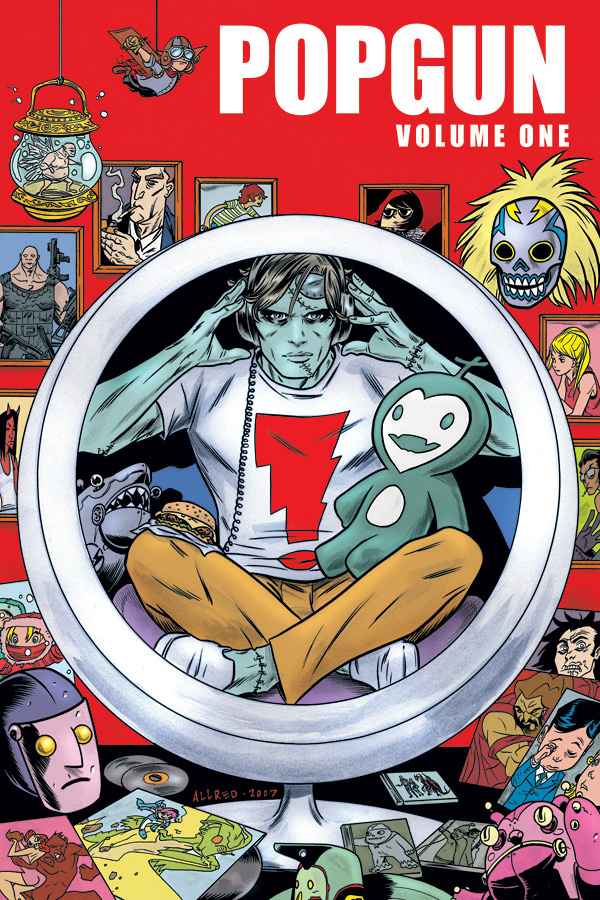
popgun1

Compilation comics have never been interesting to me. It's an odd phenomenon, because I love reading books of short stories, and I don't at all mind watching short films. Something about reading comics only two to three pages long seemed counterintuitive to me. Like maybe I wasn't getting what I paid for.

Then...

Comic conventions are playgrounds for creativity, and I can say that without the least bit of ironic pretentiousness. Maybe it's just genuinely pretentious, but whatever, conventions cannot help but be whirlwinds of imagination due to the amount of creators walking around. That's what comics have always been about for me: imagination. Stories. Entertainment. There're other things to be enjoyed - drama, emotion, etc. - and although these might not always be about smiling, rest assured that reading comics is fun.

Comic conventions, depending on the venue, can usually be depended upon to have certain things. Booth babes, cosplayers, massive lines, overpriced food, publishers selling things for cover price, venders selling things for discounts, and really weird peripheral interests like swords, juggling, and power drinks.

Inside one of those venders selling discounted books, I accidentally came across something I'd had my eye on before, but could never come to a decision regarding. My friend is the one who actually found it, and when he held it up I went, "Oh yeah." That book was "Popgun: Volume 1." It's a compilation book released by Image comics, and it features somewhere around 60 creators.

All of the stories aren't winners, but that might be one of the reasons for the book's existence: eclectic content. The styles are as varied as the stories, and there should be something for everyone. Probably the most interesting aspect of the book for me is the possibility of finding new creators I'd never heard of before. I was surprised to find out there's been four volumes of "Popgun" published already, the fourth coming out earlier this year.

If you want to discover new creators, pick up "Popgun." If you just want to read some interesting stories that take up a small portion of your day, it's good for that too. So far I enjoy it more than the one volume of "Flight" - another compilation book - I read. I've already ordered "Popgun: Volume 2."

Monday, April 5, 2010

Ex Machina #40

• NOTE • This review was written shortly after the release of issue 40, and I have re-published it here with only two changes, both regarding grammar. • NOTE •


Ex Machina 40

-Ex Machina- (eks•mock•een•uh): Referencing the Greek stage mechanism of the Gods appearing during the denouement of plays to resolve the conflict quickly and somewhat unexpectedly; Deus Ex Machina, translated, means "God from the machinery." Generally viewed as a weak or hackneyed method of wrapping up a story.

Written by Brian K. Vaughan, illustrated by Tony Harris, and published through WildStorm Comics, Ex Machina is the tale of New York City resident/Mayor/former superhero Mitchell Hundred. It takes place in many settings, including varying years. Readers have seen Hundred as a young boy asking his mother about leagues of women voters, as an adult dealing with the everyday happenings of a city that never sleeps, and also witnessed glimpses into his days as the high-flying hero, the Great Machine.

This book is definitely not hackneyed or weak.

Over the course of 40 issues readers have been taken through a tale that has touched on many different themes, some of which include a general sense of belonging, gay rights, drug use, and on and on. We may never know whether scribe Brian K. Vaughan is filling the pages of his second finite series after "Y: The Last Man" with his own beliefs and opinions, but something that is certain is his knack for crafting a compelling story, creating characters that dare to be as broad and varied as people so often are on this stage we call real life.

Likewise, Tony Harris takes Vaughan's words and turns them into gorgeous images, faces rendered so wonderfully true to life that readers can see the emotions and understand that this book is working on more than one level; it is a fantastic example of why comics are so entertaining when they are created successfully, when the art compliments the words, and vice versa.

I love this book. It arrived at a time when I was becoming somewhat more politically minded, and the idea of a superhero who ends up becoming the mayor of arguably the biggest city in the world (metaphorically) was intriguing enough for me to pick up the first issue. Vaughan managed to make a book about politics entertaining to someone (me) who finds most political conversation/theory boring and tedious, and usually gets informed of such by watching the "Daily Show."

This book has literally taught me things. At the moment the only thing I can think of is the definition of the word "constituent," but I'm positive there have been other lessons learned. Even if that isn't true, expanding my vocabulary is a win in my mind, and is certainly something America should look into.

My most recent lesson came with issue number 40, the issue I would undoubtedly characterize as Brian K. Vaughan's most personal to date. It was also my least favorite. There's something strange about this process, me selecting my least favorite issue, if for no other reason than trying to select the one read I disliked the most out of a series I like immensely is kind of counterintuitive. Alongside that, the idea that Mr. Vaughan took his personality and feelings and created this issue makes me somewhat reverent, so trashing the thing is kind of a dick move.

But then there's the critic in me, the side of my brain that realizes I won't enjoy everything, and that same side knows any artist who possesses their own critical mind understands that not everyone will enjoy everything they produce. My disappointment with the issue began the moment I saw it on the stands.

Featured on the cover is our faithful writer, Mr. Brian K. Vaughan, and his penciller, Tony Harris. Immediately I recognized the kind of story I was in for, and I think my exact reaction was something along the lines of "Ugghhhhhh." Issue 40 is a metafictional mess, a story that features the creators of the series which it is taking place in; essentially, it's like watching a movie of yourself watching a movie. I have seen the "meta" approach work very rarely, and one example is the film "Adaptation," written by Charlie Kaufman and directed by Spike Jonze. The majority of other occasions where an artist has saw fit to become self-referential has failed for me, and done nothing other than the exact thing which Brian K. Vaughan (the character) mentions in this issue: negatively affected my reading experience.

Tony Harris and Vaughan are visiting Mayor Hundred to see about working on his memoirs, which are to be published in comic book form due to the Mayor's love of the medium. While they are waiting for their appointment to arrive Tony Harris takes out his portfolio and begins sketching. "What are you working on?" Brian K. Vaughan asks. "Just sketching the two of us sitting out here in the waiting room. If we land this project, I thought it'd be cool to draw you and me into the first scene," Tony Harris responds. "Oh...yeah...I don't know, Tony. I'm not big into the whole Grant Morrison 'meta' thing. Seeing creators in a book kinda takes me out of the story, you know...?" I even view Vaughan's reference to self-referential storytelling tired, and not at all funny. In fact, while reading it, I found myself going, "Yes! You're right. This sucks."

My big problem with this issue is that it smacks of the word "filler." With issues hitting the stands with ever increasing irregularity, when I picked this one up and saw exactly what was inside, my gut reaction was that Vaughan had written something quickly, an easy story to put something out there so WildStorm would have an issue of "Ex Machina" to sell.

During the story Vaughan meets Mitchell Hundred, and they discuss his graphic novel memoirs, but quickly segue into a discussion of Vaughan's personal life, mainly his Missing-In-Action girlfriend, who moved to California for grad school.

"And why the hell didn't you follow her?" Hundred asks. This is where it may or may not get personal. Brian K. Vaughan (the character), tells of watching the first World Trade Center collapse, sitting on his roof and witnessing the mayhem. While he was out there he saw his neighbors, which is referenced as an odd occurrence for New York City. After that he describes watching the Leonids (a meteor shower) from that same vantage point, and seeing the same people whom he'd witnessed complete horror with. They were smiling, oohing and aaahing, and it was like sitting on a lawn during the 4th of July for Vaughan (the character), and thus his love for New York was defined. Hundred responds by saying that he can write comics from anywhere, no? Of course Vaughan says yes, and this is where the one piece of this issue arrives that may offer up something other than a goofy meta story designed to fill a hole on the shelf.

"If you're not with your people, a city is just a fucking place. Even this one," Hundred says. Right there, we are given Hundred's dedication and love for New York City, and that is my guess as to what Brian K. Vaughan (the writer) was trying to do with this issue. Unfortunately, if the readers had been paying attention over the previous 39 issues, they probably already knew that. After all, this is a guy who became a superhero when he realized he may be able to help people other than himself, and transitioned into the role as Mayor when he decided that would be a more actionable position. In my mind those two things prove the love of the city in themselves, so this issue was essentially unwarranted.

I have no idea if any of the stories Brian K. Vaughan (the character) relays are true or not. Maybe he did watch the horror on that day in September from his roof, maybe not. I don't know everything about the guy, and realistically, I don't want to. I do know that his wife's name is Ruth, however, and the title of this story is "Ruthless." The fictional Mayor Hundred asks why Vaughan didn't follow his girlfriend to California, and Vaughan responds, "You." So maybe that means (in reality) he stayed in New York for a little, working on this comic I love so much, and eventually realized he could write the thing from the opposite coast, where the love of his life had relocated.

Then again, maybe not. Oddly enough I've reread this issue about five times. I think I get some sort of strange satisfaction from having an issue of one of my favorite comics I dislike so much. With it being written by an author who is attempting to make this fantastic story as true to life as possible, and an artist doing the same, I came to this understanding: not every day is a great one. Through that, I came to enjoy this issue, mostly because I dislike it so much.

A Reviews Review

Internet journalism is a much different form than the increasingly outdated and ancient form of print journalism. There is simply far less attention to content when all it takes to publish opinions is a click of a mouse.

Reviews aren't normally on my reading list, but recently I woke up and decided I'd read a few. It was a sad morning.

- • -

The first review I read was interesting in that it presented a markedly staunch opinion. More than that, it was negative. The reviewer hated the book, and gave it one star out of a possible five. This was interesting because I didn't hate the book in question, and it's always interesting to read differing opinions.

Overall it was a fine review, but most of the negative aspects the reviewer mentioned seemed somewhat strange to me; the pacing, for instance. Since it was an action comic, written by a writer known largely for over-the-top action, with little to no attention to the finer details of a character and his/her development, this seemed a strange gripe to have.

I decided if I was going to run this experiment - as I was thinking of it finally - I should read another review, specifically one that had a differing opinion than the first. If I managed to find such a review, the chances were high it would fall somewhere close to my opinion, which was this: the comic was just okay.

- • -

There was in fact an opposing opinion, which isn't really so outrageous. What is the internet if not a collection of differing opinions?

The second review I read was an odd one. It purported to be praising the book, but when I looked deeper into the reviewer's words I discovered he was mixing his opinions. There was one phrase that summed up the entire review process for me: "this book is not for everyone." This statement is so obvious as to be redundant, and could potentially chop down the entire process to a much more abbreviated form.

Here is my review of the book in question, utilizing both reviews I read. "This book is not for everyone. If you like action, buy it. If you do not, then don't. The characters seem two-dimensional, but that is excusable because it's brainless violence. Rating: F or B+."

- • -

There are a few problem with comic book reviews. The most obvious is length. Most places that publish reviews of comic books are going to seek reviews that don't break past a certain amount of space, or when interpreted into the significance to the reader, a certain amount of time. After all, we're talking about comic books, which are a very limited investment of time, much more limited than novels. I certainly don't share in this opinion, because if I'm truly interested in something I'll forego any worries about wasting my time.

Maybe it's subconscious. Comic book reviewers, and the sites that publish them, don't spend too much time reviewing books because they know that the majority of those visiting the site won't read the entire review if it's too long. This may or may not have anything to do with the length of a comic, but more with the use of the internet and how it has become a tool of convenience, or a way to waste time in short increments.

- • -

There are definitely reviews out there I enjoy, but it's hard to find them. I like to read a review where the writer isn't afraid to write everything they think, and not an abbreviated form of it. The need to edit or limit a writer's space (content, meaning the amount) is understandable occasionally, more so in print than on the internet. There is no worry about printing cost or ad placement, so really the only thing restricting reviewers and their words is time; both theirs and the readers'. Honestly, what are the odds that someone read this entire posting?

My next post will be a review I wrote about a comic book I love. It is a negative review, however, and pretty long.

Thursday, February 18, 2010

Locke and Key: Issue 3 Review

Comparing "Locke and Key" to the TV show "Lost" is a big time mistake, but I've done so in the past. What I really meant to say, most likely - hindsight - was that "Locke and Key" is a well-written, well-drawn, just all around well-freaking-created mystery.

What's actually comparable between "Lost" and "Locke and Key" is how I interact with their stories; I've seen episodes of "Lost" at least three or four times, and I've read issues of "Locke and Key" just as many.

Joe Hill and Gabriel Rodriguez are putting together a story filled with mystery, questions that may or may not get answered, and something that ties all of it together nicely, a prerequisite for any good mystery, at least one that succeeds on more than one level: character.

Good mysteries are certainly capable of existing without strong characterization, but if this happens then most likely they are intriguing because the reader/viewer/interested party is surprised by something; a twist they didn't see coming, for example. Having a twist/surprise is entertaining, but taken alone they are stunted enjoyments, like riding a roller coaster without throwing your arms up.

Not all roller coasters are suitable to throw your arms up, however, and this is just as easily a metaphor for all stories not having both mystery and characterization. "Locke and Key" is not one of those books.

Issue 3 of "Locke and Key: Crown of Shadows" was released on Wednesday, February 17, and along with furthering the mystery, adding more questions, more "What Ifs" to the already towering pile of them, it is loaded with characterization, foreshadowing (ehhh, puns), and humor. While all of these aren't necessary for the creation of a good mystery, they can occasionally be added to create a streamlined-machine-of-a-mystery that is bigger, stronger, and faster than normal mysteries.

- • -

There are quite a few things I like about "Locke and Key," but one of the most desirable aspects of the book is its unpredictability. The first time the reader was given a glimpse of the anthropomorphic shadows that are referenced in title of this third "Locke and Key" storyline was during the second storyline, "Head Games."


Locke and Key: Head Games issue 1


It was a gorgeous two-page spread of the high school production of Shakespeare's "The Tempest," as performed by Rendell Locke and Lucas "Dodge" Caravaggio. The shadows have an ominous presence in the picture, and seem to be coming to life. We see beasts, warriors, and demons all lurking behind the foreground, and the reader has no idea what is going on, other than teacher Joe Ridgeway's description: "...magic."

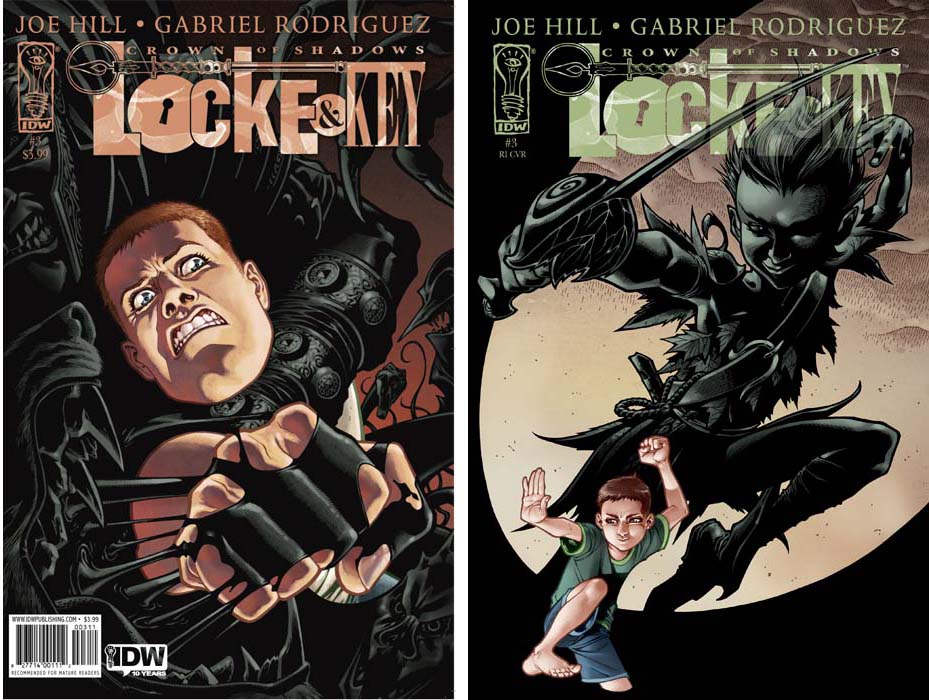
Before the titled of the third storyline was released these shadows didn't mean much to me, at least not in a direct way. I was sure they had something to do with a key, just not which one or why. After it was revealed the third storyline would be entitled "Crown of Shadows," I started forming theories about what these shadows may be, particularly when the variant covers for the issues of "Crown of Shadows" were shown. Here is the cover to issue three, along with its variant.


Locke and Key: Crown of Shadows

I had a theory that each person's shadow was defined by their inner workings, by who exactly they are. By utilizing the Shadow Key someone could activate their shadow, and thus do...something with it. This definitely wasn't my only theory regarding the story, but it was the first one to be shown as completely wrong.

Now I can go on reading "Locke and Key," forming theories, testing them, and smiling when Joe Hill and Gabriel Rodriguez send one flying by me, like they did here.

Wednesday, February 3, 2010

Paying Too Much Attention: Lost and Me (Me and Lost)


* I've already done a few entries of Paying Too Much Attention over on the Alter Ego Comic Cast Facebook page, located here. They're located under the "Notes" section, if you're interested. *

Making a list of the "greatest" anything is a fool's task. The world has just gotten over an onslaught of these with the new year's arrival, but it's not necessarily contained within that period of time. After witnessing the creation of so many lists recently I came to a conclusion: humans love to make lists. You know who loves making lists the most? Nerds.

We'll list our favorite anything, our least favorite anything, list after list of what turns us on or off, and no matter how successful one list seems there is always another in the works.

I only bring it up because the premiere of "Lost" finally happened, and I want, so desperately want, to call it the greatest maxi-series of all time, but I know the kind of weight held by those words, and don't sling them around lightly.

- • -

When "Lost" premiered I was a very different person. Not drastically, I guess - for instance, I still cared about all of the things I do now - so my experience with the show wasn't what it is now. I can actually remember lying on my bed, flipping channels and accidentally witnessing the plane crash from the pilot episode. The sound was perfect, the visuals were exciting, the acting was sharp, and I felt as if I were there, on the beach with these poor souls.

I changed the channel. There was no mental mechanism controlling my hand, it just happened. My only description for why this happened is on that particular night I had no desire to see or read or do anything that required brain functions.

Later, the DVD had been released, and I'm not even sure what made it appear on my radar. As far as I can remember now, the series wasn't registering for me at all, and if anything I started to care - or at least think about caring - because a friend started talking about how great it was. I borrowed his DVD, and asked how long it would take before I was hooked.

"Dude...first episode," he said.

Five years, five DVD sets, hours of conjecture, guesswork, theorizing, and just plain nerding out, the show is coming to an end. The first episode of the sixth season proves to me that this whole "Lost" experience is having a huge effect on me, far more than any TV show ever has in the past, and possibly - just maybe - more than one will in the future.

It's a unique experience, because aside from being completely entertained by the show, it's also giving me a good sense of storytelling, the pieces fitting together wonderfully. A large number of writers - and every other role inside the movie/TV business - are working together so seamlessly, operating at such a level of success that is normally not seen.

I've been able to separate my enjoyment of the show into two categories, almost dividing my mind up, allowing it to exist on separate planes. Even after the last episode is aired, and secrets revealed or explained, I will return to this show and watch it again and again. It's good Sci-Fi, drama, comedy, action; it has, and will continue to teach me how to be a good viewer (a skill easily transferrable to other mediums: reader, listener, etc.), and it will help me understand the makings of a good story.

Maybe one day I'll do a Paying Too Much Attention that actually discusses the show and its plots, but right now I'm much more content with what the show is doing to me.